Reebok i-Bike Review 2026

Reebok · Indoor Cycle Review

Reebok i-Bike Review 2026

The Reebok i-Bike proves a connected bike does not have to cost a fortune. A compact, quiet magnetic cycle that pairs with Zwift and Kinomap, with no subscription, for £349, or £314.10 with the GOAL10 code. For smaller homes and tighter budgets, it is one of the easiest connected bikes to recommend.
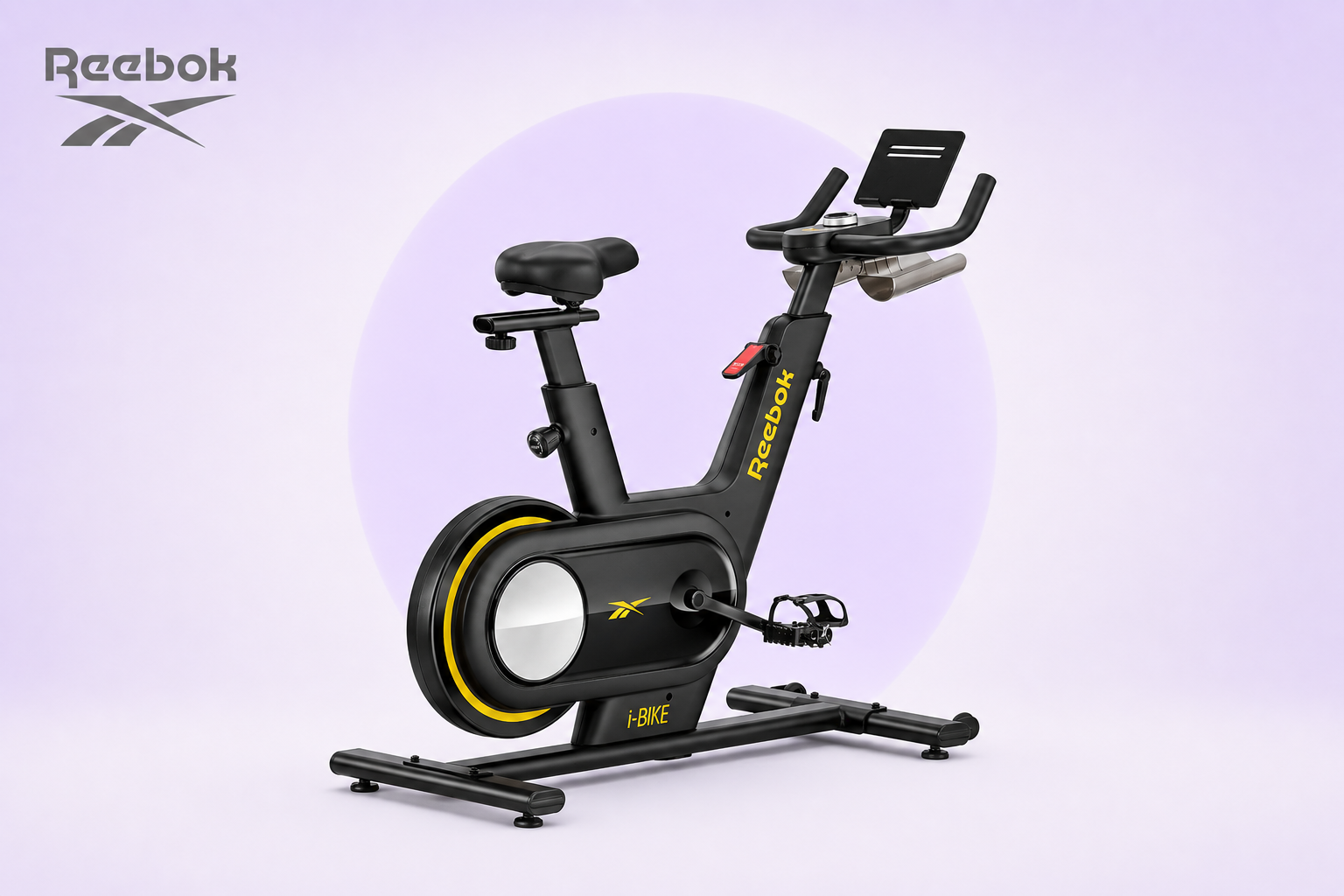
Reebok i-Bike indoor cycle

Reebok i-Bike

Compact connected indoor cycle

4.1/5
FitRank
Very good
Performance3.9
Build4.0
Value4.4
Features4.2
£349£399
GOAL10 → £314.10 Check price at Reebok

Price and any code applied at checkout via Sweatband

The verdict

The i-Bike keeps things simple and affordable without feeling cheap. The 8kg flywheel and 32 levels of computer-controlled magnetic resistance give a smooth, quiet ride that suits steady cardio and app-led sessions, and the rotating dial makes adjusting intensity quick and intuitive. It will not have the heft of a heavier bike on hard standing efforts, but for daily fitness and virtual rides it is more than smooth enough.

What lifts it above a basic budget bike is the connectivity and the comfort. It pairs over Bluetooth with Zwift, Kinomap and the Reebok Console app, so you can ride virtual routes on your own tablet, and the cushioned, fully adjustable seat, multi-position bars and self-levelling pedals make it genuinely family-friendly. The main limit to note is the 110kg user weight: within that, it is a lot of connected bike for the money.

Strengths

  • Connects to Zwift and Kinomap, no subscription
  • Compact and light, easy to move and store
  • Quiet, smooth magnetic resistance
  • Self-levelling pedals and a family-friendly fit
  • Inexpensive, especially with the GOAL10 code

Watch-outs

  • Light 8kg flywheel, less momentum on hard efforts
  • 110kg user weight limit
  • No Peloton or Rouvy support, unlike the Z-Tech
  • No built-in screen, you supply the tablet

Ride feel and real-world experience

The i-Bike is a compact, easy-going ride. The 8kg fixed Reebok Flow flywheel is on the lighter side, so it spins up quickly and suits steady cardio, app-led rides and getting a sweat on before work rather than heavy, grinding standing climbs, where you would feel the lack of the momentum a heavier flywheel provides. The 32 levels of computer-controlled magnetic resistance are adjusted on a neat rotating dial, and like all magnetic systems the ride is smooth and quiet, which is a big part of the appeal in a flat or a shared home.

Comfort and fit are better than the price suggests. The cushioned seat adjusts both vertically and horizontally and the soft-touch handlebars offer multiple positions, so the whole family can find a comfortable fit, and the self-levelling pedals mean you can simply hop on in trainers without clipping in. At a compact 131 by 51cm and 35.5kg it is stable for its size and easy to move. The 110kg user limit is the one figure to check before buying: it is lower than the heavier bikes, so taller or heavier riders should size up to the Z-Tech.

Assembly, size and setup

The i-Bike is the easier of the two to set up and live with. It arrives as a self-assembly bike with the tools included, and at 35.5kg it is light enough for one person to build and position within an hour. Its compact 131 by 51cm footprint suits smaller rooms, and the transport wheels make it genuinely easy to wheel out of the way, which is a large part of why it works for homes where the bike cannot live out permanently.

Living with it: noise, footprint and storage

This is the Reebok for tight spaces and shared homes. The magnetic resistance is quiet, so early-morning and evening rides will not disturb anyone, and the compact footprint and 35.5kg weight mean it is the one Reebok you can realistically tuck away after a session. The cushioned seat and multi-position bars make it comfortable for casual daily use, and upkeep is minimal, with no friction pads to wear, just the occasional wipe-down. The adjustable tablet holder keeps your screen at a sensible angle for app-led rides.

Apps and connectivity

Despite the low price, the i-Bike is a connected bike. It pairs over Bluetooth with Zwift, Kinomap and the Reebok Console app, so you can race virtual routes, ride real-world roads and follow structured sessions on your own tablet, with a 60-day free Kinomap trial included. It does not list the Peloton or Rouvy support that the Z-Tech adds, but for a bike at this price the core app trio covers most riders. As with all Reebok bikes there is no compulsory subscription, so you use whichever app you like, free or paid, or just the bike’s own console.

Running costs: the no-subscription advantage

The i-Bike’s running costs are about as low as a connected bike gets. There is no Reebok subscription, no app licence and no membership: you pay once for the bike, and the apps are entirely your choice, from free tiers to paid plans. At £349, or £314.10 with the GOAL10 code, it is already inexpensive, and the absence of an ongoing fee keeps it that way. Set against a subscription bike like the Echelon EX-30 RCX, whose classes need a monthly membership to be worthwhile, the i-Bike’s pay-once openness is a real part of its budget appeal.

How it compares

At £349, or £314.10 with GOAL10, the i-Bike’s natural rivals are the other budget connected bikes. The JTX Cyclo-3M at £299 is cheaper and well built but has no app connectivity at all, so the i-Bike earns its small premium by adding Zwift and Kinomap. The Echelon EX-30 RCX lands near the same money when discounted, but ties you to Echelon’s paid classes, where the i-Bike lets you bring your own app with no subscription. Within the Reebok range, step up to the Z-Tech Sprint if you want a heavier flywheel, electromagnetic auto-resistance, Peloton support and a higher user limit.

Who it is for

Buy the i-Bike if you want an affordable, compact connected bike for steady cardio and app-led rides, and you are comfortably within its 110kg limit. It is ideal for smaller homes, families and beginners who want Zwift or Kinomap without a subscription or a big spend. If you want a heavier, more road-like ride, electromagnetic auto-resistance or a higher user weight limit, the Z-Tech Sprint is the step up. If you do not need apps at all, the subscription-free JTX Cyclo-3M is a cheaper option.

Specifications

Bike typeSpin (indoor cycle)
Flywheel8kg fixed (Reebok Flow)
ResistanceMagnetic, 32 levels (computer-controlled)
ConsoleRotating dial: speed, distance, time, RPM, calories, pulse, resistance
AppsZwift, Kinomap, Reebok Console
PedalsSelf-levelling with foot straps
HandlebarsSoft-touch, multi-position
SeatPadded, vertical and horizontal adjustment
Maximum user weight110kg
Machine weight35.5kg
Assembled size131 x 51 x 102 cm
Programmes17 (12 pre-set)
Warranty2 years, home use

Warranty and after-sales

Reebok covers the i-Bike with a 2-year warranty for home use, the same term as the Z-Tech. That covers the bike against faults for two years from purchase, a standard level for a budget connected bike, and it is sold and supported in the UK through Sweatband. Register the bike on arrival and keep your proof of purchase. As with the Z-Tech, the magnetic resistance has no friction parts to wear, so mechanical wear should be low in normal home use.

FitRank breakdown

Performance 3.9

The 8kg flywheel suits steady cardio and app-led rides more than hard standing climbs, but the magnetic resistance is smooth and quiet through all 32 levels.

Build quality 4.0

A compact 35.5kg frame that is stable for its size. The 110kg user limit is the main thing to check before buying.

Value 4.4

A connected bike with Zwift and Kinomap support for £314 with GOAL10, and no subscription, is good value for smaller budgets.

Features 4.2

App connectivity, a rotating dial console, 17 programmes and self-levelling pedals cover the essentials. It drops the Peloton and Rouvy support of the Z-Tech.

Frequently asked questions

Does the Reebok i-Bike need a subscription?
No. It connects to Zwift, Kinomap and the Reebok Console app, and works on its own console too. There is no compulsory subscription, and a 60-day free Kinomap trial is included.
Which apps work with the i-Bike?
Zwift, Kinomap and the Reebok Console app over Bluetooth. It does not list the Peloton or Rouvy support that the Z-Tech offers.
What is the user weight limit?
110kg. If you are near that figure, the Z-Tech Sprint, rated to 150kg, is the sturdier long-term choice.
Is the 8kg flywheel enough?
For steady cardio and app-led riding, yes, it is smooth and quiet. For hard standing climbs and a more road-like feel, the heavier Z-Tech is the better choice.
Does the i-Bike have a screen?
No. You mount your own tablet on the adjustable holder to run the apps.
Is the i-Bike good for families and beginners?
Yes. The fully adjustable seat and handlebars and self-levelling pedals make it easy for different riders to share, and you can hop on in trainers without clipping in.
What warranty does it come with?
A 2-year warranty for home use, sold and supported in the UK through Sweatband.
Chris Linford, fitness equipment reviewer
Chris Linford · Fitness equipment reviewer
Chris writes the home fitness reviews across our sites, including our sister site HomeTreadmill.co.uk. He compares every machine against its rivals on UK pricing and specs, and scores each one with FitRank.

We may earn a commission if you buy through links on this page, at no extra cost to you. It never affects our FitRank score. See our affiliate disclosure.
← Back to all Reebok bikes

Reebok Z-Tech Sprint Review 2026

Reebok · Indoor Cycle Review

Reebok Z-Tech Sprint Review 2026

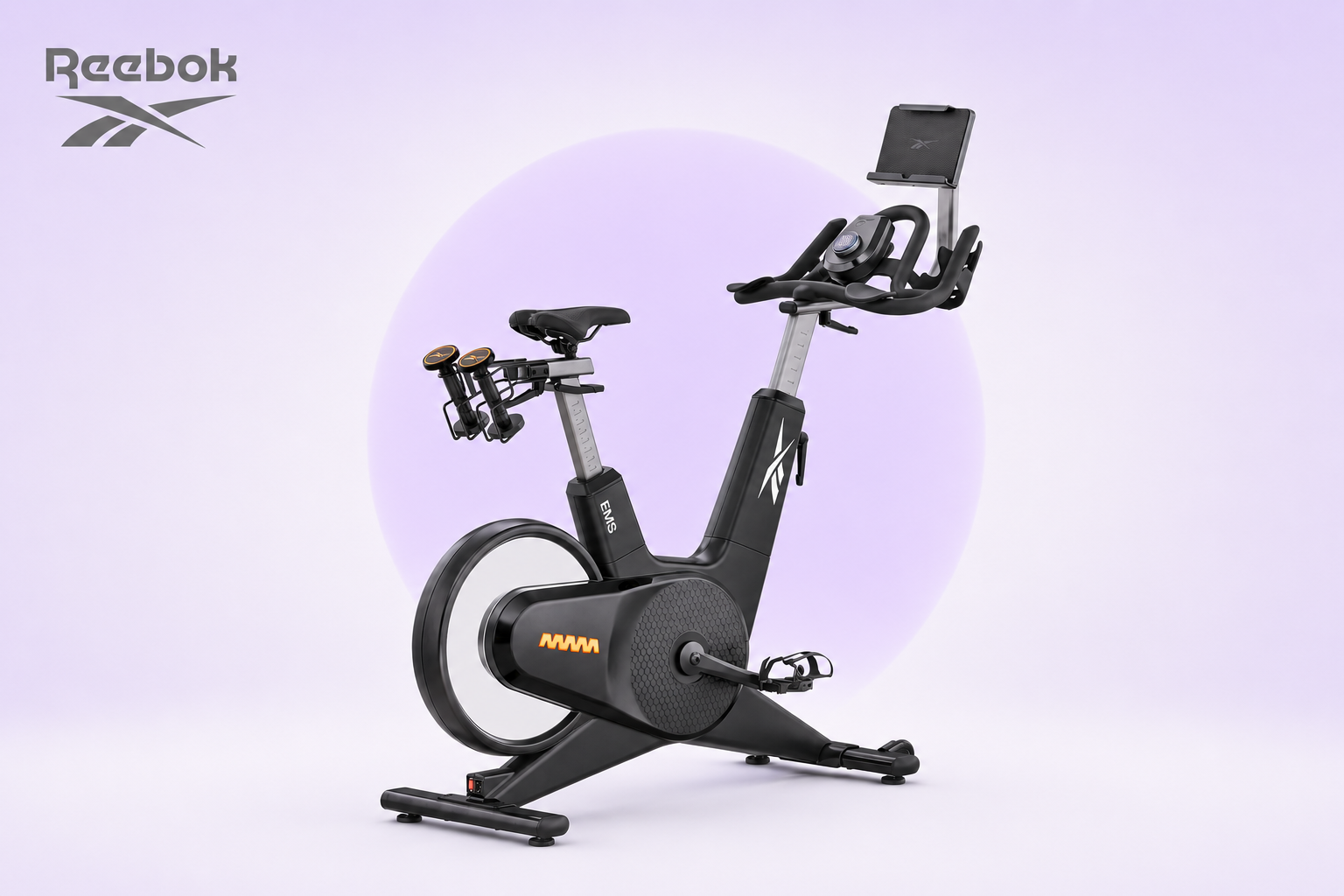
The Reebok Z-Tech Sprint is the rare connected bike that does not tie you to a subscription. Electromagnetic, app-controllable resistance, a 13kg flywheel and compatibility with Zwift, Kinomap, Peloton and Rouvy, all for £699, or £629.10 with the GOAL10 code. If you want a performance bike that works with your apps rather than the maker’s, this is the one to look at.

Reebok Z-Tech Sprint indoor bike

Reebok Z-Tech Sprint

Connected spin bike, electromagnetic resistance

4.5/5
FitRank
Excellent
Performance4.5
Build4.4
Value4.6
Features4.6
£699£900
GOAL10 → £629.10 Check price at Reebok

Price and any code applied at checkout via Sweatband

The verdict

The Z-Tech gets the fundamentals right and then adds the features that usually cost more. The 13kg flywheel gives a smooth, road-like ride with real momentum, while the 50 levels of electromagnetic resistance are finer and more precise than a typical magnetic dial. The clever part is that the resistance is app-controllable, so a Zwift workout or a Kinomap climb can adjust it for you automatically, which is the kind of immersive, hands-off riding normally reserved for pricier smart bikes.

Around that sits a genuinely well-equipped package: a padded racing saddle, multi-grip bars with forearm rests for an aero position, gripped pedals that take cleats or trainers, a USB-C charging tablet holder and even a pair of dumbbells for off-bike work. The one thing to be clear about is that, like its rivals, there is no built-in screen, so you run the apps on your own tablet. Given the breadth of app support and the lack of any forced subscription, that is the flexible, cheaper way to do it.

Strengths

  • Electromagnetic, app-controllable resistance with 50 levels
  • Works with Zwift, Kinomap, Peloton and Rouvy, no subscription
  • 13kg flywheel for a smooth, road-like ride
  • Forearm rests, racing saddle and a high 150kg user limit
  • USB-C charging tablet holder and dumbbells included

Watch-outs

  • No built-in screen, you supply the tablet
  • A large, heavy bike that needs a permanent spot
  • 2-year warranty is shorter than JTX’s in-home cover
  • As a newer bike, independent long-term feedback is still limited

Ride feel and real-world experience

On the bike, the Z-Tech rides like a proper performance machine. The 13kg flywheel carries real momentum, so the pedal stroke is smooth and road-like rather than light, with the seamless, rhythmic cadence you want for longer efforts and sprints alike. What sets it apart from most bikes at this price is the resistance: 50 levels of electromagnetic resistance, which is both finer than a typical magnetic dial and, crucially, app-controllable, so in a Zwift workout or a Kinomap or Rouvy route the bike can adjust your resistance automatically as the gradient changes. That turns a session into something far more immersive than manually twisting a knob.

The riding position is built for comfort over distance. The padded racing saddle adjusts vertically and horizontally, and the multi-grip handlebars add built-in forearm rests for an aero, triathlon-style position the cheaper bikes do not offer. The gripped pedals take a cage or a clip-in cleat, so you can ride in trainers or cycling shoes, and the LED dial console reports speed, distance, time, RPM, calories, watts and resistance. As a newer bike, independent long-term owner feedback is still limited, but the specification and build, a 59kg frame rated to 150kg with floor levellers, point to a stable, planted ride.

Assembly, size and setup

The Z-Tech arrives as a self-assembly bike with the tools included, and the process follows the usual spin-bike pattern: stabilisers, pedals, seat, handlebars and the tablet holder. At 59kg it is a substantial bike, so it is worth having a second person to position it, after which the heavy-duty transport wheels make it easy to move and the floor levellers give a stable, wobble-free platform. It is a tall, long bike at 150 by 52 by 146cm, so measure your space, including headroom, before it arrives.

Living with it: noise, footprint and storage

Electromagnetic resistance is quiet, so the Z-Tech is well suited to flats, shared homes and early-morning or late-night sessions where noise matters. It is not a bike you will be tucking away, though: at 59kg with a tall, long footprint it wants a permanent home, and the floor levellers are there to keep it planted once you have placed it. Upkeep is minimal, since electromagnetic resistance has no pads or contact parts to wear, just the occasional wipe-down and a bolt check. The rotatable tablet holder takes up to a 15.6-inch tablet and charges it over USB-C, a genuinely useful touch for long app-led rides.

Apps and connectivity

This is the Z-Tech’s headline strength. It connects over Bluetooth to a wider set of apps than almost any bike at this price: Zwift, Kinomap, Peloton, Rouvy and the Reebok Console app. That means you can follow Peloton’s instructors, race virtual worlds in Zwift, ride real-world routes in Kinomap or Rouvy, or just use the bike’s own console, and because the resistance is electromagnetic, the apps that support it can drive your resistance automatically. A 60-day free Kinomap trial is included. There is no compulsory Reebok subscription, so you bring whichever app you like, on a free or paid plan, or none at all.

Running costs: the no-subscription advantage

What the Z-Tech does not cost you is a forced monthly fee. Unlike an Echelon or a Peloton, where the bike is built around that brand’s paid membership, the Z-Tech is yours to use with whatever app you choose, including the Peloton app itself, on your own terms. Over two or three years a class subscription can quietly add up to more than the bike, so a rider who already pays for Zwift or Peloton Digital, or who wants no subscription at all, can save a great deal over a locked-in bike at a similar price. It is the pay-once model with the broadest app choice on the market.

How it compares

At £699, or £629.10 with the GOAL10 code, the Z-Tech sits between two bikes we rate highly and beats both on flexibility. The Echelon EX-5 at £799 has a similar 13kg flywheel but locks you into Echelon’s paid app, while the Z-Tech is cheaper and works with everything including Peloton. Our top pick, the JTX Studio Pro at £799, counters with a heavier 16kg flywheel and a semi-commercial frame, but only connects to Zwift and Kinomap and lacks the Z-Tech’s app-controlled electromagnetic resistance. Against a Peloton the Z-Tech is far cheaper and frees you from the membership, though you supply your own screen rather than getting a built-in touchscreen. For app flexibility and auto-resistance at the money, the Z-Tech is hard to beat.

Who it is for

Buy the Z-Tech Sprint if you want a performance bike that works with your choice of app, especially if you already use Zwift, Kinomap or the Peloton app and do not want a forced subscription. The electromagnetic auto-resistance, forearm rests and 150kg limit make it the pick for serious, longer training. If you want a heavier flywheel and a semi-commercial frame and only need Zwift, the JTX Studio Pro is the alternative; if you specifically want built-in instructor classes, the Echelon EX-5 is the subscription route. For a compact, cheaper Reebok, see the i-Bike.

Specifications

Bike typeSpin (indoor cycle)
Flywheel13kg
ResistanceElectromagnetic, 50 levels (app-controllable)
ConsoleLED dial: speed, distance, time, RPM, calories, watts, resistance
AppsZwift, Kinomap, Peloton, Rouvy, Reebok Console
PedalsGripped, with cages and clip-in option
HandlebarsMulti-position with built-in forearm rests
SeatPadded racing saddle, vertical and horizontal adjustment
ExtrasUSB-C tablet charging, 2 x 1.5kg dumbbells
Maximum user weight150kg
Machine weight59kg
Assembled size150 x 52 x 146 cm
PowerMains
Warranty2 years, home use

Warranty and after-sales

Reebok covers the Z-Tech with a 2-year warranty for home use, covering the bike against faults from purchase. That is in line with Echelon’s cover and a standard term for a connected bike at this price, though shorter than JTX’s in-home, multi-year warranties. It is sold and supported in the UK through Sweatband, so register the bike on arrival and keep your proof of purchase. As the resistance is electromagnetic with no friction parts to wear, the mechanical demands on the warranty should be low in normal home use.

FitRank breakdown

Performance 4.5

A 13kg flywheel and 50 levels of electromagnetic resistance give a smooth, road-like ride with precise, app-controllable intensity. The auto-resistance in Zwift and Kinomap lifts it above a manual magnetic bike.

Build quality 4.4

A 59kg frame rated to 150kg, with floor levellers and a racing saddle. Stable and well equipped, if a large bike to house.

Value 4.6

Electromagnetic resistance, five-app support and a 150kg limit for £629 with GOAL10 is strong value, undercutting locked-in rivals at a similar price.

Features 4.6

The widest app support here, including Peloton, plus USB-C charging, forearm rests and included dumbbells. Only the lack of a built-in screen holds it back.

Frequently asked questions

Does the Reebok Z-Tech need a subscription?
No. It works on its own console and connects to the apps you choose. There is no compulsory Reebok subscription, and a 60-day free Kinomap trial is included.
Which apps work with the Z-Tech?
Zwift, Kinomap, Peloton, Rouvy and the Reebok Console app, all over Bluetooth. Because the resistance is electromagnetic, supported apps can also adjust it automatically.
Can I use the Z-Tech with Peloton?
Yes. It is compatible with the Peloton app over Bluetooth, so you can follow Peloton classes without buying Peloton’s own bike.
What is electromagnetic resistance?
A finer, more precise resistance system than a manual magnetic dial, and one that supported apps can control automatically as the gradient changes in a workout or route.
Does the Z-Tech have a screen?
No. You mount your own tablet on the rotatable holder, which charges it over USB-C and takes up to a 15.6-inch device.
Is the Z-Tech good for taller or heavier riders?
Yes. It has a 150kg user weight limit and a fully adjustable saddle and handlebars, making it the more accommodating of the two Reebok bikes.
What warranty does it come with?
A 2-year warranty for home use, sold and supported in the UK through Sweatband.
Chris Linford, fitness equipment reviewer
Chris Linford · Fitness equipment reviewer
Chris writes the home fitness reviews across our sites, including our sister site HomeTreadmill.co.uk. He compares every machine against its rivals on UK pricing and specs, and scores each one with FitRank.

We may earn a commission if you buy through links on this page, at no extra cost to you. It never affects our FitRank score. See our affiliate disclosure.
← Back to all Reebok bikes

Reebok Exercise Bikes: The Connected Cycles Compared

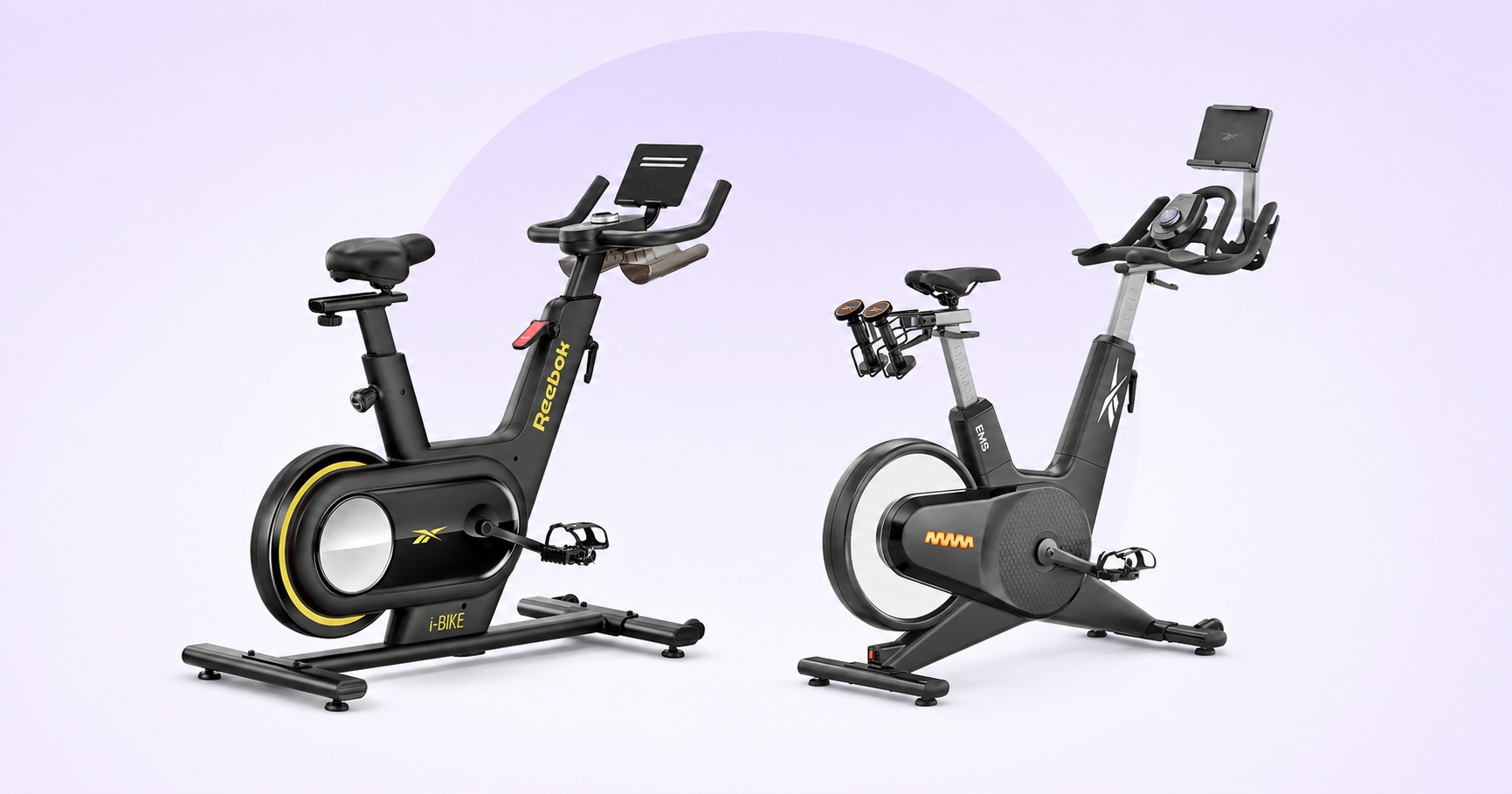
The Reebok Z-Tech Sprint and i-Bike connected exercise bikes compared

Brand Hub

Reebok Exercise Bikes: The Connected Cycles Compared

Reebok’s two connected indoor cycles, the Z-Tech Sprint and the i-Bike, take a refreshingly open approach: no compulsory subscription, and they connect to the apps you already use, including Zwift, Kinomap and even Peloton. These are the more capable bikes in Reebok’s line-up, and here is how they compare, scored with FitRank.

Both bikes are sold through Sweatband in the UK, and both come with a 60-day free Kinomap trial and a 2-year warranty. What sets them apart from a brand like Echelon is openness. Where an Echelon bike ties you to its own paid app, Reebok’s bikes are app-agnostic: they pair over Bluetooth with whichever training app you prefer, or none at all, with no monthly fee of Reebok’s own. Reebok does make simpler indoor bikes as well, including the FR30 and FR30 Sprint sold through Argos, but this guide focuses on its two more capable connected cycles. The Z-Tech Sprint is the premium bike, with electromagnetic resistance and a performance focus, while the i-Bike is the compact, more affordable connected option. We have scored both with FitRank below.

Reebok Z-Tech Sprint indoor bike
Best overall

Reebok Z-Tech Sprint

FitRank 4.5£699£900GOAL10 → £629.10

The premium Reebok: a 13kg flywheel, 50 levels of app-controllable electromagnetic resistance, forearm rests and the widest app support here, Zwift, Kinomap, Peloton and Rouvy. A lot of bike for the sale price.

Reebok i-Bike indoor cycle
Best compact

Reebok i-Bike

FitRank 4.1£349£399GOAL10 → £314.10

The compact, affordable entry: an 8kg flywheel, 32 levels of computer-controlled magnetic resistance, self-levelling pedals and Zwift and Kinomap support. A tidy bike for smaller homes and tighter budgets.

Reebok exercise bikes compared

ModelFlywheelResistanceAppsMax userPriceFitRank
Z-Tech Sprint13kgElectromagnetic, 50 levelsZwift, Kinomap, Peloton, Rouvy, Reebok150kg£699 (£629.10 with GOAL10)4.5
i-Bike8kg fixedMagnetic, 32 levelsZwift, Kinomap, Reebok110kg£349 (£314.10 with GOAL10)4.1

Both share Bluetooth, a rotating dial or LED console, 17 workout programmes, a tablet holder, a 60-day Kinomap trial and a 2-year warranty. The Z-Tech adds USB-C tablet charging and a pair of 1.5kg dumbbells.

Open platform: no subscription, your choice of app

This is the best reason to look at Reebok. Both bikes connect over Bluetooth to the training apps you choose, rather than locking you into one ecosystem. The i-Bike works with Zwift, Kinomap and the Reebok Console app, while the Z-Tech adds Peloton and Rouvy on top, so you can follow Peloton’s coaches, race virtual routes in Zwift, ride real-world roads in Kinomap or Rouvy, or simply use the bike’s own console. Crucially, there is no compulsory Reebok subscription: you pay for whichever app you want, on a free tier or a paid plan, or nothing at all. Both bikes include a 60-day free Kinomap trial to get you started. For anyone who wants the flexibility to switch apps, or to avoid a forced monthly fee, that openness is a real advantage over a closed system like Echelon or Peloton’s own hardware.

Electromagnetic or magnetic resistance?

The two bikes use different resistance systems, and it is the main thing separating them. The Z-Tech Sprint uses 50 levels of electromagnetic resistance, which is finer and, importantly, app-controllable: in a Zwift workout or a Kinomap route the app can adjust your resistance for you as the gradient changes, giving a more immersive, automatic ride. The i-Bike uses 32 levels of computer-controlled magnetic resistance, adjusted on its rotating dial. Both are quiet and smooth, but the Z-Tech’s electromagnetic system gives more precise control and the auto-resistance feature that performance-minded riders and structured-workout fans will appreciate.

Reebok discount codes and sales

Both Reebok bikes are already discounted from their RRP at Sweatband, and the code GOAL10 takes a further 10% off at checkout. At the time of writing that brings the Z-Tech Sprint down to £629.10 from a £900 RRP, and the i-Bike to £314.10 from £399. Sale prices and codes change, so it is worth checking the current offer before you buy, and we flag the live discount on each bike in the cards above.

What about the Reebok FR30, FR30 Sprint and other bikes?

Reebok’s range is wider than the two bikes here. The FR30 and FR30 Sprint are simpler indoor cycles sold through Argos, sitting below the Z-Tech and i-Bike on features and connectivity, and if you have been searching for a while you may also have come across older models like the ZR8, ZR9 and ZR10. We focus on the Z-Tech Sprint and the i-Bike because they are the more capable, app-connected machines and the ones we would steer most buyers towards. If you are weighing up an FR30 or an older Reebok bike, the i-Bike is the natural connected choice at the affordable end, and the Z-Tech Sprint at the performance end.

How to choose a Reebok bike

Compact and affordable, or premium and performance?

The decision is fairly clear-cut. The i-Bike is the one for smaller homes and tighter budgets: it is compact at 131 by 51cm, lighter to move, and connects to the core apps for a fraction of the Z-Tech’s price. The Z-Tech Sprint is the one for performance and immersion: a heavier 13kg flywheel for a more road-like ride, electromagnetic auto-resistance, forearm rests for an aero position, a 150kg user limit and the broadest app support, including Peloton.

Check the user weight limit

One practical point worth flagging: the i-Bike is rated to 110kg, while the Z-Tech supports up to 150kg. If you are near the i-Bike’s limit, the Z-Tech is the sturdier, more comfortable long-term choice.

Is Reebok a good brand for exercise bikes?

Reebok is a long-established name, and its two indoor cycles punch above their price, particularly on the sale prices they tend to sell at. The open, app-agnostic approach is the highlight: broad compatibility with Zwift, Kinomap, Peloton and Rouvy, no forced subscription, and a 2-year warranty on both bikes. The Z-Tech in particular offers a specification, electromagnetic resistance, a 13kg flywheel, a 150kg limit and five compatible apps, that usually costs more elsewhere. If you want a connected bike without being tied to one company’s monthly fee, Reebok makes a strong case.

Reebok versus Echelon and Peloton

The contrast comes down to open versus closed. An Echelon or a Peloton bike is built around that brand’s own app and paid membership, which buys you a polished class experience but locks you in and keeps charging. Reebok takes the opposite approach: the hardware is yours, and you bring whichever app you like, including the Peloton app itself on the Z-Tech. You give up the seamless all-in-one feel of a built-in touchscreen, since you supply your own tablet, but you gain flexibility and avoid a compulsory fee. For riders who already use Zwift or Peloton Digital, or who simply do not want another subscription, Reebok is the more sensible buy. For those who want the slickest out-of-the-box class experience, Echelon or Peloton still lead.

Frequently asked questions

Do Reebok bikes need a subscription?
No. Both bikes work on their own console and connect to third-party apps of your choice. There is no compulsory Reebok subscription, and both include a 60-day free Kinomap trial.
Which apps work with Reebok bikes?
The Z-Tech Sprint connects to Zwift, Kinomap, Peloton, Rouvy and the Reebok Console app. The i-Bike connects to Zwift, Kinomap and the Reebok Console app. All over Bluetooth.
What is the difference between the Z-Tech and the i-Bike?
The Z-Tech Sprint is the premium bike: a 13kg flywheel, electromagnetic app-controlled resistance, a 150kg user limit and the widest app support. The i-Bike is compact and cheaper, with an 8kg flywheel, magnetic resistance and a 110kg limit.
Is there a Reebok discount code?
At the time of writing the code GOAL10 takes a further 10% off at Sweatband, bringing the Z-Tech to £629.10 and the i-Bike to £314.10. Codes change, so check the current offer.
Can I use a Reebok bike with Peloton?
Yes, on the Z-Tech Sprint. It is compatible with the Peloton app over Bluetooth, so you can follow Peloton classes without buying Peloton’s own bike. The i-Bike does not list Peloton support.
What warranty do Reebok bikes come with?
Both carry a 2-year warranty for home use.

For exercise bikes beyond Reebok, see our main best exercise bikes guide, and read how we score every product on the FitRank page.

Chris Linford, fitness equipment reviewer
Chris Linford · Fitness equipment reviewer
Chris writes the home fitness reviews across our sites, including our sister site HomeTreadmill.co.uk. He compares every machine against its rivals on UK pricing and specs, and scores each one with FitRank.

← All exercise bikes

Echelon EX-Pro Review 2026

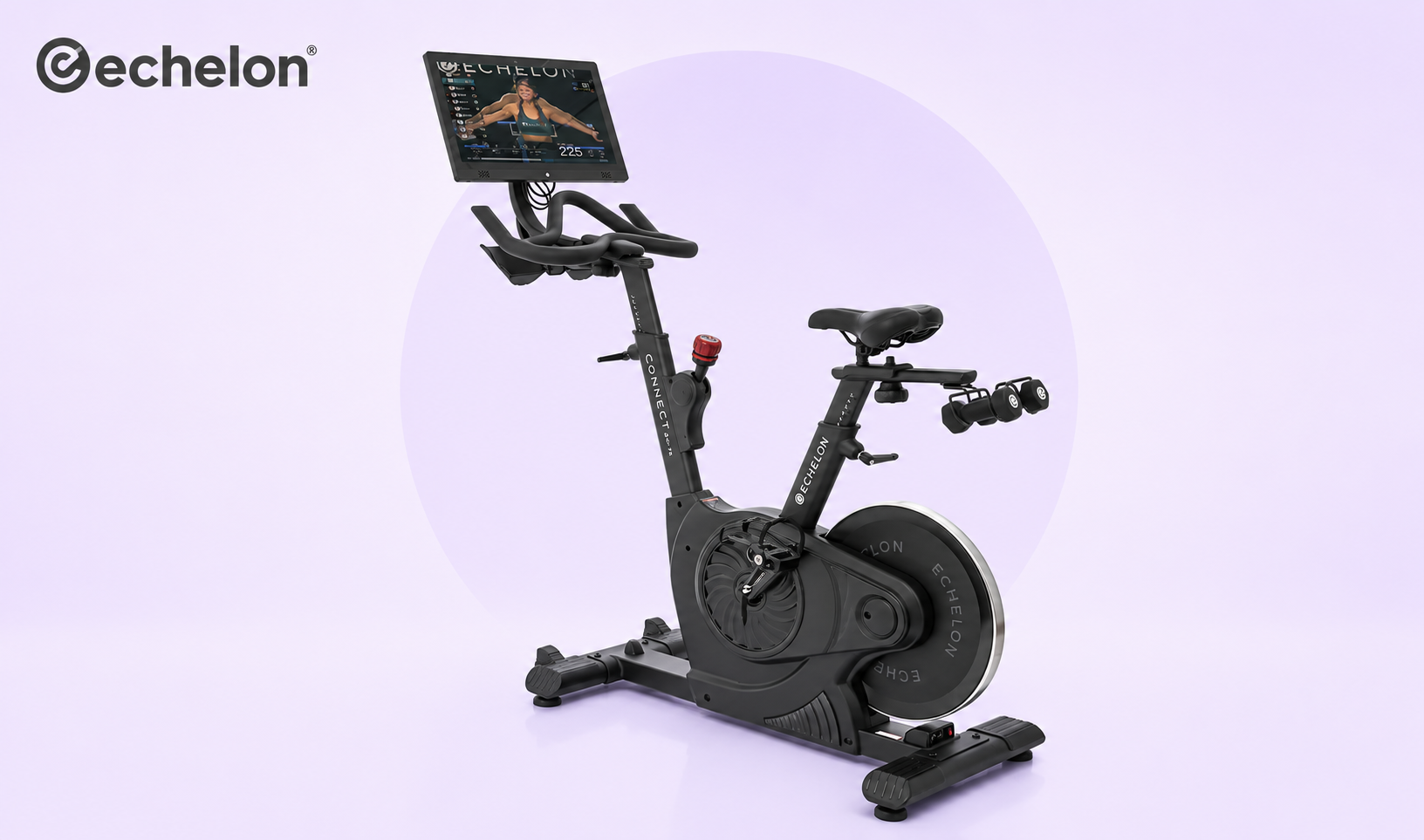
Echelon EX-Pro Commercial connected indoor cycle

Echelon · Indoor Cycle Review

Echelon EX-Pro Review 2026

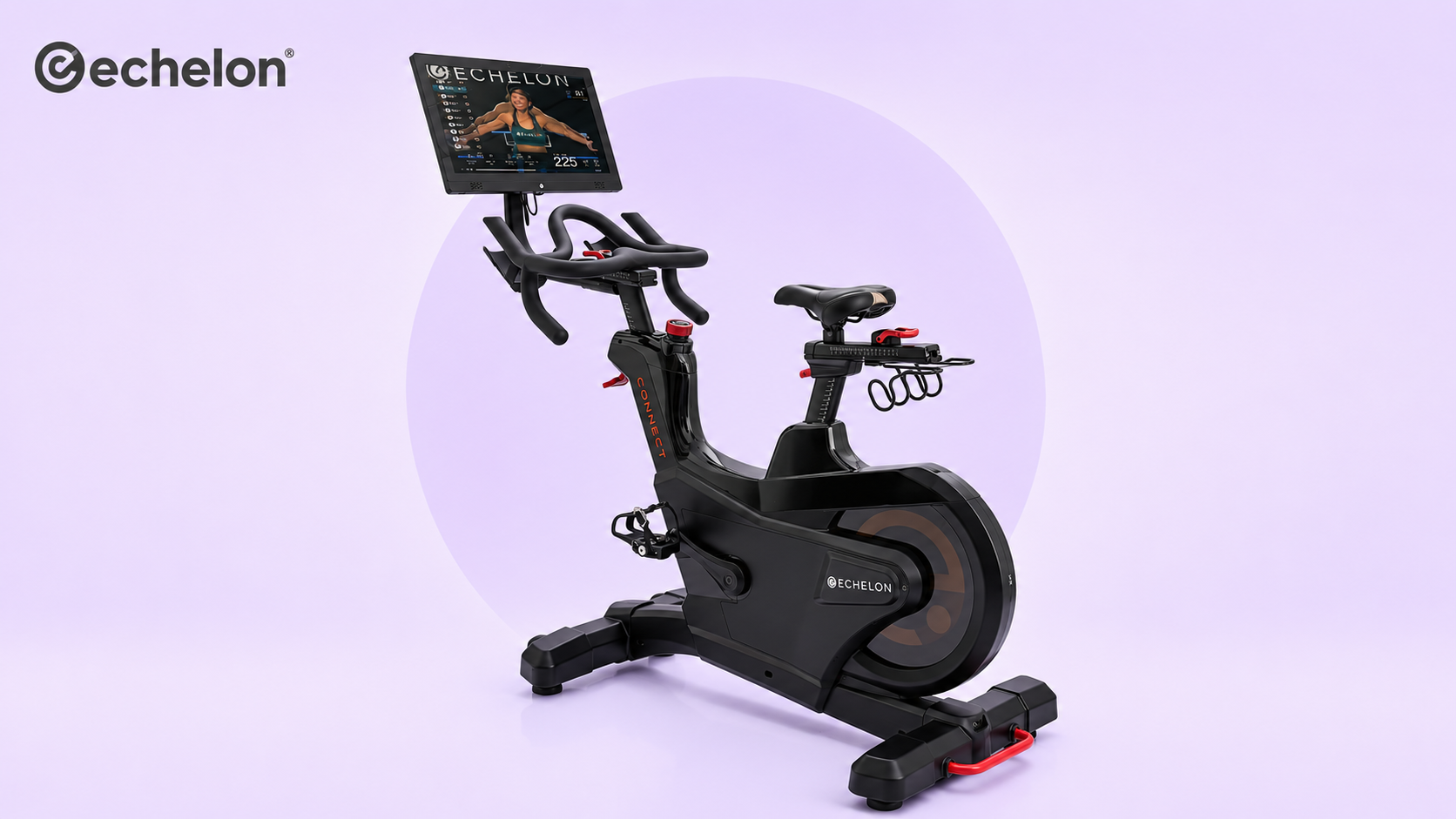
The EX-Pro is Echelon’s commercial flagship, the bike you would find in a boutique studio. A 24-inch HD touchscreen, fast-reacting EMS indexing resistance, aero handlebars and a 159kg user limit put it in a different class to the rest of the range, with a price to match.

Echelon EX-Pro Commercial connected indoor cycle

Echelon EX-Pro

Commercial connected indoor cycle

4.5/5
FitRank
Excellent
Performance4.7
Build4.8
Value3.9
Features4.8
£2,999
Check price at Echelon

Price and any code applied at checkout via Sweatband

The verdict

This is the most capable bike Echelon makes. The 24-inch HD touchscreen is the largest in the range and flips 180 degrees for off-bike classes, while the EMS indexing resistance reacts almost instantly, which matters in instructor-led classes where the resistance call changes every few seconds. The belt drive is quiet, the multi-adjustable aero handlebars suit serious riders, and at 75kg with a 159kg user limit it is rock solid no matter how hard you ride.

It is rated for unlimited commercial use, which tells you who it is really for: studios, gyms and high-end home setups where the bike will be ridden hard by many people. For a home buyer it is undeniably brilliant, but most will not need this much bike, and the £2,999 price is a lot to pay over the EX-5S or EX7s for benefits, like the indexing resistance and commercial warranty, that only some riders will use. If you want the very best and the budget is there, it delivers. Otherwise, the EX-5S remains the value-led choice.

Strengths

  • 24-inch rotating HD touchscreen, the largest in the range
  • Fast EMS indexing resistance for class changes
  • Commercial-grade build, 159kg user limit
  • Aero handlebars and quiet belt drive
  • Rated for unlimited commercial use

Watch-outs

  • Expensive at £2,999
  • Far more bike than most home users need
  • Heavy at 75kg
  • Membership needed for the classes

Ride feel and real-world experience

The EX-Pro is the most capable and most planted ride Echelon makes. The belt drive is silent, and the standout is the resistance system: rather than the manual knob of the cheaper bikes, the EX-Pro uses fast-reacting EMS indexing resistance that changes almost instantly, which genuinely matters in an instructor-led class where the resistance call shifts every few seconds. At 75kg it is the heaviest bike in the range by some margin, and that mass translates into rock-solid stability no matter how hard you ride.

The multi-adjustable aero handlebars and competition-style seat suit serious riders, and the 24-inch screen, the largest Echelon fits, pivots 180 degrees for off-bike classes. With a 159kg user limit it accommodates a wider range of riders than the 136kg bikes below it. This is a bike built to be ridden hard and often, and it feels it, though the firm performance saddle is still one most riders will want to break in or upgrade.

Assembly, size and setup

As a commercial-grade machine the EX-Pro is heavy at 75kg, so assembly and positioning are firmly a two-person task, ideally more for getting it into place. The build is straightforward with the supplied tools, but the weight and the large screen make it the most demanding install in the range. Measure carefully, including clearance for the rotating screen, and decide on its final home before it arrives, because it is not a bike you will move on a whim.

Living with it: noise, footprint and storage

The EX-Pro is the largest and heaviest bike in the range at 75kg, and it is built to stay exactly where you install it. It does not fold, needs clearance for the 24-inch screen to rotate, and really wants a dedicated space, whether that is a home gym room or a studio floor. The belt drive keeps it quiet despite the commercial build, but the sheer mass means installation is a job for two or more, and once it is down it is not moving without effort. Plan the location carefully before delivery.

The Echelon app and subscription

The EX-Pro runs everything on its 24-inch screen, with the 45-day Premier Membership trial included and unlimited user profiles, so a household or a studio can each keep their own progress. The classes need the ongoing subscription and an internet connection. As Echelon’s commercial bike, its membership is geared towards multi-user settings, and wired CAT6 connectivity alongside wireless makes it suited to a gym network. Manual riding and Strava, Apple Health and Fitbit syncing remain available without a subscription.

Is the subscription worth it?

On a £2,999 commercial bike the subscription is almost beside the point: anyone spending this much is buying into the Echelon ecosystem wholesale, and the unlimited user profiles and commercial membership are designed for studios and shared settings where many riders use the classes. For a home buyer, the more useful value check is whether you need a commercial machine at all, because the EX-5S delivers the same class library and a 22-inch screen for roughly a third of the price. If the answer is a genuine commercial setting, the membership and the bike make sense together.

How it compares

At £2,999 the EX-Pro is priced against commercial studio bikes from the likes of Stages and Life Fitness rather than home machines, and for most people at home it is simply more bike than they need. The far more sensible home comparison is in-range: the EX-5S gives you the same class platform and a 22-inch screen for roughly a third of the price, and even the premium EX7s undercuts it by a thousand pounds. If you want a subscription-free home bike instead, our top pick the JTX Studio Pro covers that for £799. The EX-Pro earns its price only if you want a true commercial machine or are kitting out a studio.

Who it is for

The EX-Pro is for studios, gyms and high-end home gyms that want the best Echelon makes. Home riders chasing value will be better served by the EX-5S, and those who want a premium home bike without full commercial spend should look at the EX7s.

Specifications

ResistanceMagnetic, EMS indexing, 32 levels
DriveBelt
Screen24-inch rotating HD touchscreen (180-degree flip)
HandlebarsMulti-adjustable aero
PedalsCommercial dual-sided SPD plus cage
ConnectivityBluetooth, wired or wireless (CAT6), Echelon Fit, syncs Strava, Apple Health, Fitbit
Maximum user weight159kg
Machine weight75kg
Warranty2 years parts and labour, unlimited commercial use

Warranty and after-sales

The EX-Pro is rated for unlimited commercial use, the highest classification in the range, and carries a 2-year parts and labour warranty. That commercial-unlimited rating means it is certified for the kind of all-day, multi-user duty a studio or gym demands, not just home use, which is part of what you are paying for at this price. Cover runs two years on both parts and labour, it is sold and supported through Sweatband in the UK, and you should register it and retain proof of purchase.

FitRank breakdown

Performance 4.7

Fast EMS indexing resistance and a heavy, stable frame make for the most responsive, studio-accurate ride in the range.

Build quality 4.8

A 75kg commercial-grade frame with a 159kg user limit, rated for unlimited commercial use. As solid as Echelon gets.

Value 3.9

The lowest score here, not because it is bad but because the £2,999 price is far more than most home users need to spend.

Features 4.8

The 24-inch screen, indexing resistance, aero bars and wired networking are the most complete feature set in the range.

Frequently asked questions

Is the EX-Pro worth it for home use?
For most home users, no. The EX-5S offers the same classes and a 22-inch screen for around a third of the price. The EX-Pro is worth it only if you want a commercial-grade machine or are fitting out a studio.
What is EMS indexing resistance?
It is a fast-reacting resistance system that changes almost instantly when you turn the control or follow a class instruction, which suits the rapid resistance changes of instructor-led sessions better than a standard manual knob.
How many people can use it?
It supports unlimited user profiles and is rated for unlimited commercial use, so it suits households and studios where many riders share the bike.
Is the EX-Pro quiet?
Yes. The belt drive and magnetic resistance keep it quiet despite its size and commercial build.
Is the EX-Pro suitable for a commercial gym?
Yes. It is rated for unlimited commercial use with unlimited user profiles, which is exactly what a studio or gym needs.
Does the EX-Pro fold or move easily?
No. At 75kg it is the heaviest bike in the range and is designed to stay in place; installation needs at least two people.
Chris Linford, fitness equipment reviewer
Chris Linford · Fitness equipment reviewer
Chris writes the home fitness reviews across our sites, including our sister site HomeTreadmill.co.uk. He compares every machine against its rivals on UK pricing and specs, and scores each one with FitRank.

We may earn a commission if you buy through links on this page, at no extra cost to you. It never affects our FitRank score. See our affiliate disclosure.
← Back to all Echelon bikes

Echelon EX7s Review 2026

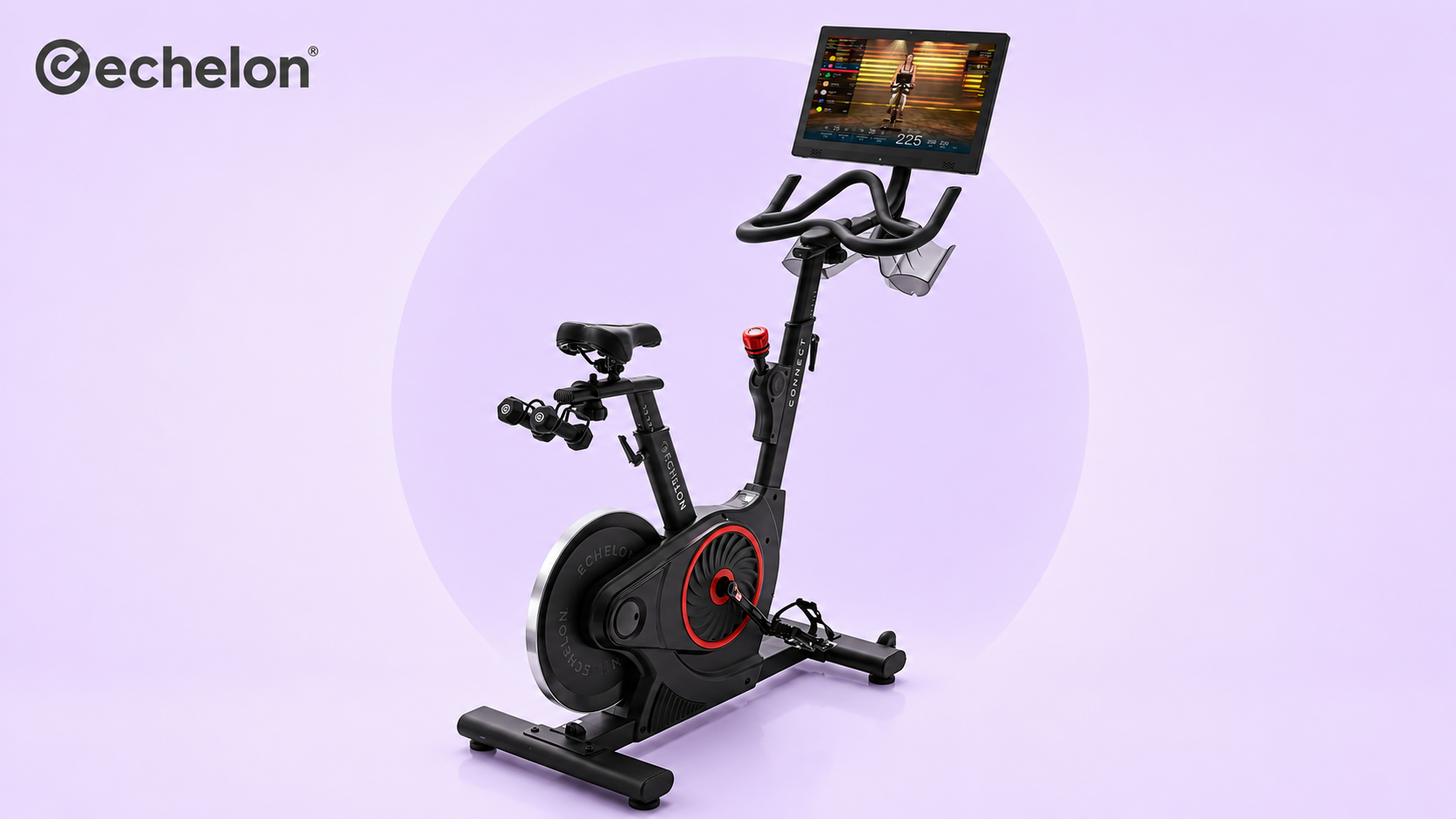
Echelon EX7s Smart Connect indoor cycle

Echelon · Indoor Cycle Review

Echelon EX7s Review 2026

The EX7s is Echelon’s premium connected bike, built to a light-commercial standard with a 22-inch rotating HD touchscreen, a quiet belt drive and bullhorn handlebars. It is made for riders who want immersion and a frame that will take years of hard use.

Echelon EX7s Smart Connect indoor cycle

Echelon EX7s

Premium connected indoor cycle

4.4/5
FitRank
Excellent
Performance4.5
Build4.6
Value4.0
Features4.7
£1,999
Check price at Echelon

Price and any code applied at checkout via Sweatband

The verdict

Everything about the EX7s is geared towards a studio-style experience at home. The 22-inch HD touchscreen rotates 180 degrees for off-bike classes, the belt drive keeps things quiet and low-maintenance, and the elevated bullhorn handlebars with an elbow rest give you an aggressive, aero riding position the cheaper bikes do not. The frame is rated for light-commercial use, so it is comfortable in a shared household or a small studio.

The honest question is value. At £1,999 the EX7s costs nearly double the EX-5S, and the two share the same 22-inch screen and the same app. What you are paying the premium for is the belt drive, the bullhorn bars, the wired connectivity options and the heavier-duty commercial-grade frame. If those things matter to you, it is a lovely bike. If they do not, the EX-5S gives you the core experience for a lot less, which is the comparison most buyers should make.

Strengths

  • 22-inch rotating HD touchscreen
  • Quiet, low-maintenance belt drive
  • Light-commercial frame
  • Bullhorn bars with elbow rest
  • Wired or wireless connectivity

Watch-outs

  • Nearly double the price of the EX-5S for a similar experience
  • Heavy and large
  • Membership needed for the classes

Ride feel and real-world experience

The EX7s is the most refined ride in the range. Its belt drive, a ribbed Poly-V design, runs whisper-quiet and needs virtually no maintenance, and reviewers consistently describe the resistance, adjusted through 32 indexed levels on a responsive knob, as smooth and progressive. The heavier flywheel and frame give a planted, seamless feel that the lighter bikes cannot match.

The standout at the contact points is the elevated bullhorn handlebar with built-in elbow rests, which gives more hand positions and a more aggressive, aero posture than the rest of the range, though some reviewers would still prefer true drop bars. The competition-style seat is supportive but, like most performance saddles, firm on long rides. Quad-adjustable bars and seat fit riders from roughly 4 foot 5 to 6 foot 8, and the 22-inch screen pivots 180 degrees for off-bike work. As on the other screen bikes, expect a touch of screen movement during all-out efforts. Front-facing speakers and a clear, responsive touchscreen round out the immersive feel, and an integrated tablet holder and dual bottle holders keep everything within easy reach mid-session.

Assembly, size and setup

At 53kg with a tall frame and a large screen, the EX7s is firmly a two-person assembly and install. The build itself is straightforward with the supplied tools and takes around an hour, and once in place the transport wheels allow small repositioning. It is a big bike, so measure your space, including room for the screen to rotate, before it arrives.

Living with it: noise, footprint and storage

The EX7s is a large, heavy bike at 53kg with a tall frame, so it commands a proper space rather than a spare corner. It does not fold, and you need clearance for the 22-inch screen to rotate. The belt drive and magnetic resistance make it one of the quietest bikes in the range, which is welcome in a flat or shared home, and the build feels made to stay put: once installed, you will move it only rarely, on its transport wheels, for cleaning or the occasional reshuffle.

The Echelon app and subscription

Everything runs on the built-in 22-inch screen, with the 45-day Premier Membership trial included and the classes requiring the ongoing subscription and an internet connection afterwards. The EX7s also offers wired connectivity through a CAT6 port as well as wireless, which is a nice touch if your home network is patchy where the bike lives. A point worth knowing for power users: the community QZ app can bridge an Echelon bike to other platforms and add automatic resistance, though that is a third-party workaround rather than an official feature. Manual riding and third-party syncing work without a membership.

Is the subscription worth it?

As a premium touchscreen bike, the EX7s leans on the subscription as much as the EX-5S does, since the on-board screen is built around the Echelon classes. The harder value question here is not the membership but the hardware: you are paying nearly twice the EX-5S for the same screen and app, so the subscription maths are identical and the extra outlay buys frame and finish rather than a better class experience. If you want the classes and a light-commercial build, the membership is part of the deal; if you only want the classes, the cheaper EX-5S reaches the same library.

How it compares

At £1,999 the EX7s competes with premium connected bikes like the Peloton Bike Plus and the NordicTrack S22i, but the closest question is simpler and closer to home: why not the EX-5S? The two share the same 22-inch screen and app, and the EX-5S costs several hundred pounds less, so the EX7s only makes sense if you specifically want its belt drive, bullhorn bars, wired networking and light-commercial frame. If you would rather avoid a subscription altogether, the JTX Studio Pro delivers a heavier flywheel and Zwift for £799, albeit without a screen or classes.

Who it is for

Buy the EX7s if you want a premium, light-commercial bike and the aero bullhorn riding position. Most people who simply want the screen will find the EX-5S gives the core experience for far less. If you want a full commercial machine, the EX-Pro is the flagship.

Specifications

DriveMagnetic, belt drive
Resistance32 levels
Screen22-inch rotating HD touchscreen (180-degree flip)
HandlebarsElevated bullhorn with elbow rest
PedalsSPD plus cage
ConnectivityBluetooth, wired or wireless (CAT6), Echelon Fit, syncs Strava, Apple Health, Fitbit
Maximum user weight136kg
Machine weight53kg
Warranty2 years parts and labour, commercial-rated frame

Warranty and after-sales

The EX7s steps up to a commercial-rated frame, and Echelon backs it with a 2-year parts and labour warranty. The commercial rating means the frame is built and certified for heavier, shared use, such as a small studio or a busy household, rather than single-user home duty, which is reassuring at this price. Cover runs for two years on both parts and labour, it is sold through Sweatband in the UK, and you should register it and keep your receipt.

FitRank breakdown

Performance 4.5

A smooth, quiet belt drive and an aggressive bullhorn position make for an immersive, studio-style ride.

Build quality 4.6

A light-commercial frame rated for heavy, shared use, with wired connectivity options. Built to last.

Value 4.0

The weak spot. At nearly twice the EX-5S for a similar screen and app, you pay a real premium for the frame and finish.

Features 4.7

A 22-inch rotating screen, belt drive, bullhorn bars and wired networking add up to a premium feature set.

Frequently asked questions

Is the EX7s worth it over the EX-5S?
They share the same screen and app. The EX7s adds a belt drive, bullhorn bars, wired connectivity and a commercial-grade frame for around £900 more. For most home users the EX-5S is the smarter buy; the EX7s suits those who want the premium build or light-commercial use.
Is the EX7s quiet?
Yes. The ribbed Poly-V belt drive and magnetic resistance make it one of the quietest bikes in the range, fine for flats and shared spaces.
Does the EX7s need a tablet?
No. The 22-inch touchscreen is built into the bike.
Can it be used in a small studio?
Yes. Its frame is rated for light-commercial use, so it suits shared households and small studios as well as demanding home users.
Does the EX7s fold away?
No. It is a large, heavy bike that does not fold, and it needs space for the screen to rotate.
Does the EX7s screen need a subscription?
Yes, to access the classes it is built around. Manual riding and third-party syncing work without one.
Does the EX7s work with other apps like Peloton or Zwift?
Echelon bikes are built around the Echelon Fit app and sync to Strava, Apple Health and Fitbit. Some owners use the third-party QZ app to bridge an Echelon bike to other platforms and add automatic resistance, but that is an unofficial workaround rather than a supported feature.
Chris Linford, fitness equipment reviewer
Chris Linford · Fitness equipment reviewer
Chris writes the home fitness reviews across our sites, including our sister site HomeTreadmill.co.uk. He compares every machine against its rivals on UK pricing and specs, and scores each one with FitRank.

We may earn a commission if you buy through links on this page, at no extra cost to you. It never affects our FitRank score. See our affiliate disclosure.
← Back to all Echelon bikes

Echelon EX-5S Review 2026

Echelon EX-5S Smart Connect indoor cycle

Echelon · Indoor Cycle Review

Echelon EX-5S Review 2026

The EX-5S is the value pick of Echelon’s touchscreen bikes. Take the EX-5’s excellent 13kg ride, bolt on a 22-inch rotating HD screen, and you have a fully self-contained connected bike for around £1,099, several hundred less than the EX7s above it.

Echelon EX-5S Smart Connect indoor cycle

Echelon EX-5S

Connected indoor cycle with 22-inch touchscreen

4.5/5
FitRank
Excellent
Performance4.5
Build4.5
Value4.4
Features4.6
£1,099£1,349
Save 19% Check price at Echelon

Price and any code applied at checkout via Sweatband

The verdict

The ride is the EX-5’s, and that is a compliment: the 13kg flywheel gives real momentum, the SPD pedals let you clip in, and the vented performance seat adjusts to fit. What you add over the EX-5 is the 22-inch HD touchscreen, which rotates 180 degrees so you can step off the bike and follow strength, yoga or boxing classes on the same screen. Everything runs on board, with no tablet to mount or charge.

It is a heavier bike at 56kg, so it is less something you wheel around between sessions, but that mass is part of why it feels planted. With the current 19% off it lands close to four figures, which for a 22-inch connected bike with a heavy flywheel is strong value. Unless you specifically want the bullhorn bars and light-commercial frame of the EX7s, the EX-5S gives you most of the same experience for noticeably less.

Strengths

  • 22-inch rotating HD touchscreen built in
  • Heavy 13kg flywheel for a road-like ride
  • Rotates for off-bike strength and yoga classes
  • Strong value among the touchscreen bikes
  • 19% off at the time of writing

Watch-outs

  • Heavy at 56kg, not easy to move
  • Membership needed for the classes
  • Still a premium price next to the no-screen EX-5

Ride feel and real-world experience

The EX-5S takes the EX-5’s well-regarded 13kg ride and adds the screen, and reviewers consistently describe the result as sleek, stable and well made. The magnetic resistance is quiet through all 32 levels, the performance seat and aero handlebars adjust to fit a wide range of heights, and the grippy bars hold up even when a session gets sweaty. As with the EX-5, the Q-factor is wider than a Peloton’s, so the stance feels slightly broader if you are coming from a road bike.

The headline is the 22-inch HD touchscreen, which pivots a full 180 degrees so you can swing it round and follow strength, yoga or boxing classes off the bike. It is a genuinely useful feature. The one trade-off testers note on big-screen bikes like this is a little screen wobble during very hard out-of-the-saddle efforts, and at 56kg the EX-5S is a bike you place once rather than move often. It does not fold or store vertically, so it needs a permanent home.

Assembly, size and setup

Assembly follows the familiar spin-bike routine and takes around an hour with the tools provided, but at 56kg this is a two-person job: the screen and frame make it awkward for one. Once built, the transport wheels help with small adjustments to position, though you will not be wheeling it far. Allow space not just for the footprint but for the screen to rotate.

Living with it: noise, footprint and storage

At 56kg and with a 22-inch screen on board, the EX-5S is a bike you place once and leave. It does not fold or store vertically, so it needs a permanent home with enough clearance for the screen to swing through its full 180-degree rotation. The magnetic resistance keeps it quiet in use, which helps in a flat, but the size and weight mean two people for the initial install and only occasional nudges on the transport wheels thereafter. Factor the screen rotation into your room plan, not just the footprint.

The Echelon app and subscription

With the screen built in, the EX-5S runs everything on board: classes, metrics and the off-bike workouts all live on the 22-inch display. The 45-day Premier Membership trial is included, after which the classes need the ongoing subscription and an internet connection, and it is fair to say the touchscreen is far less useful without a membership than a bring-your-own-tablet bike would be. The class library is mature and well regarded, though the free-ride side of the platform, FitOS World, is still developing and is not yet a rival to the likes of Zwift. Manual riding and Strava, Apple Health and Fitbit syncing work without the subscription.

Is the subscription worth it?

On a touchscreen bike the subscription question changes shape. Unlike a bring-your-own-tablet bike, the EX-5S’s built-in screen is far less useful without a membership, so you are realistically committing to the ongoing fee to get the most from it. The flip side is that the classes are mature and well regarded, and at the current membership rates Echelon usually works out cheaper to run than Peloton. Use the 45-day trial to be sure the class style suits you, because the value of this bike specifically is tied to actually using the screen it is built around.

How it compares

Most reviewers place the EX-5S closest to the original Peloton Bike on price and features, and it makes a strong case as the cheaper, more flexible alternative, with the advantage that it syncs openly to Strava, Apple Health and Fitbit. Against the iFit-based NordicTrack bikes it trades their auto-adjusting incline for a lower price and a simpler ride. If you would rather skip the subscription model entirely, our top pick, the JTX Studio Pro, gives you a heavier flywheel and Zwift support for £799 and no monthly fee, though you lose the built-in screen and the classes. Within the Echelon range, the EX-5S is the value choice against the £1,999 EX7s, which it closely matches on screen and app for several hundred pounds less.

Who it is for

The EX-5S is the best all-in-one for most people who want the screen built in. If you already own a tablet and want to save, the EX-5 gives the same ride for less. If you want a light-commercial frame and bullhorn bars, the EX7s is the step up.

Specifications

Flywheel13kg
ResistanceMagnetic, 32 levels
Screen22-inch rotating HD touchscreen (180-degree flip)
PedalsSPD compatible plus cage
SeatVented performance, vertical and horizontal adjustment
ConnectivityBluetooth, Echelon Fit, syncs Strava, Apple Health, Fitbit
Maximum user weight136kg
Machine weight56kg
PowerMains
Warranty2 years parts and labour (home use)

Warranty and after-sales

Echelon gives the EX-5S a 2-year parts and labour warranty, rated for home use. That covers both components and repair labour for two years, which is a fair level for a touchscreen bike in this class, and the screen and electronics are covered under the same terms as the frame and mechanicals. It is sold and supported in the UK through Sweatband, so register the bike on arrival and keep proof of purchase, which matters more on a bike with a screen to go wrong.

FitRank breakdown

Performance 4.5

The same strong 13kg ride as the EX-5, with SPD pedals and a performance seat. Excellent for class-led and free riding alike.

Build quality 4.5

A planted 56kg frame and a 136kg user limit. Solidly built, if heavy to move.

Value 4.4

The best-value touchscreen Echelon, especially with 19% off. Most of the EX7s for hundreds less.

Features 4.6

The 22-inch rotating screen, on-board classes and off-bike workouts make it genuinely self-contained.

Frequently asked questions

What is the difference between the EX-5S and the EX7s?
Both have a 22-inch rotating screen and run the same app. The EX7s adds a belt drive, bullhorn handlebars and a light-commercial frame, while the EX-5S is cheaper and shares the EX-5’s 13kg ride.
How does the EX-5S compare with Peloton?
The EX-5S is usually cheaper than a comparable Peloton and syncs openly to Strava, Apple Health and Fitbit, where Peloton is more closed. Peloton’s class community is larger and its software more polished. For value and flexibility, the EX-5S makes the stronger case.
Does the screen wobble?
As with most big-screen bikes, testers note a little screen movement during very hard out-of-the-saddle efforts. It is not a dealbreaker, but it is a known trait of bikes with a 22-inch display.
Does the Echelon EX-5S need a tablet?
No. The 22-inch HD touchscreen is built into the bike, so the classes and metrics run on board.
Does the EX-5S fold?
No. It does not fold or store vertically, and you need room for the screen to rotate 180 degrees.
Is the EX-5S screen useful without a subscription?
Far less so. The built-in screen is built around the Echelon classes, which need the membership, so a bring-your-own-tablet bike makes more sense if you do not want to subscribe.
Chris Linford, fitness equipment reviewer
Chris Linford · Fitness equipment reviewer
Chris writes the home fitness reviews across our sites, including our sister site HomeTreadmill.co.uk. He compares every machine against its rivals on UK pricing and specs, and scores each one with FitRank.

We may earn a commission if you buy through links on this page, at no extra cost to you. It never affects our FitRank score. See our affiliate disclosure.
← Back to all Echelon bikes

Echelon EX-5 Review 2026

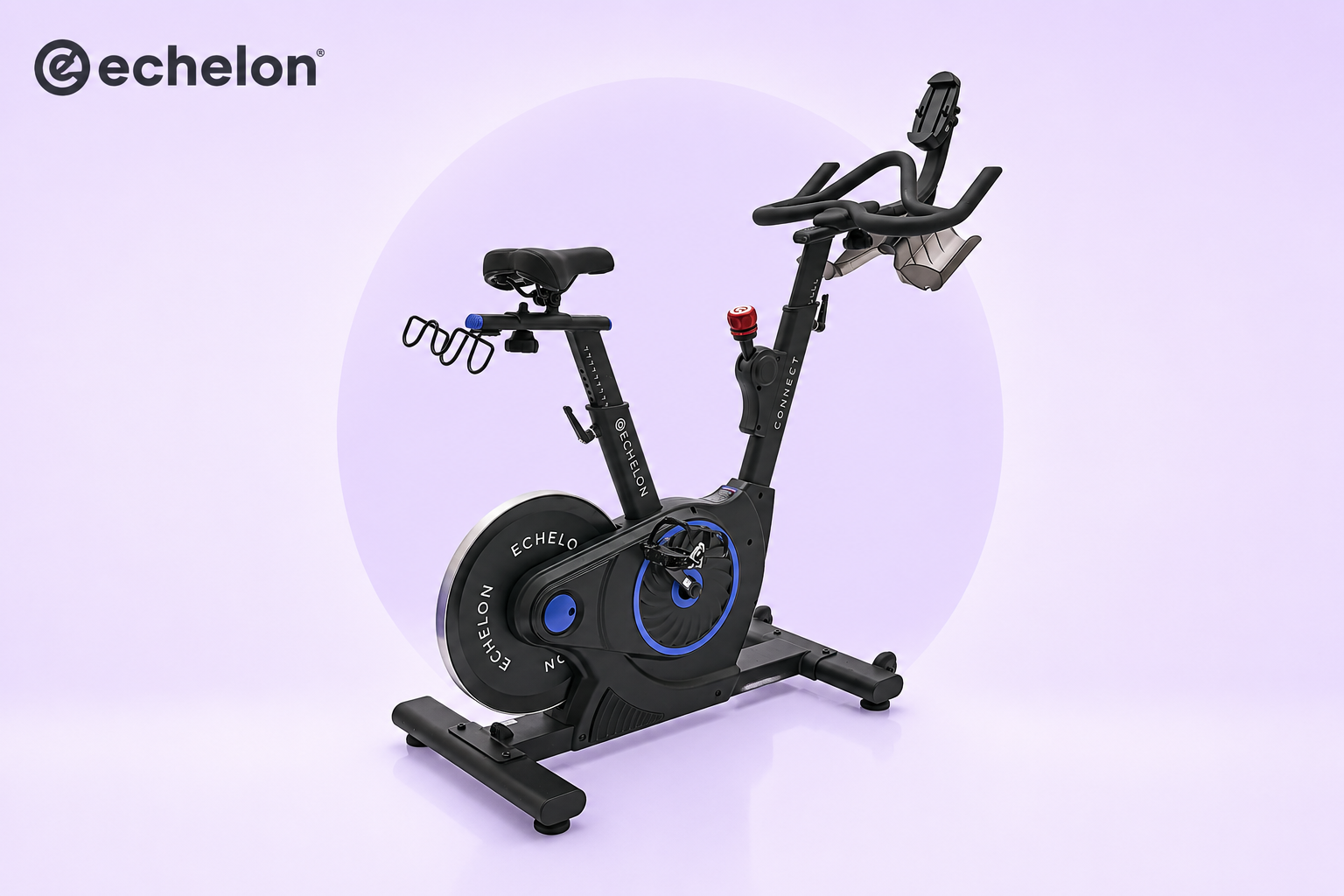
Echelon EX-5 Smart Connect indoor cycle

Echelon · Indoor Cycle Review

Echelon EX-5 Review 2026

The EX-5 is where the Echelon range starts to feel like a serious bike. A heavier 13kg flywheel, SPD pedals and a competition-style seat give it a properly road-like ride, and because there is no built-in screen, you get that ride for hundreds less than the touchscreen models.

Echelon EX-5 Smart Connect indoor cycle

Echelon EX-5

Connected indoor cycle, bring your own screen

4.3/5
FitRank
Excellent
Performance4.4
Build4.4
Value4.2
Features4.2
£799£999
Save 20% Check price at Echelon

Price and any code applied at checkout via Sweatband

The verdict

Step on the EX-5 after one of the 7kg bikes and the difference is immediate. The 13kg flywheel carries far more momentum, which makes standing climbs and sprints feel smooth and natural rather than light and spinny. The competition-style seat has a 6-inch lever adjustment and the bike fits riders from roughly 4 foot 5 to 6 foot 8, so it suits a wide range of body shapes, and the SPD-compatible pedals let you clip in for a more efficient stroke.

The catch, if it is one, is that you supply the screen. You mount a tablet to run the Echelon Fit app and its classes, syncing as usual to Strava, Apple Health and Fitbit. For a lot of riders that is the smart trade: put the money into the ride rather than a screen you may not need, since most people already own a tablet. If you want the same 13kg ride with a 22-inch touchscreen built in, that is exactly what the EX-5S offers for a few hundred pounds more.

Strengths

  • Heavier 13kg flywheel for a road-like ride
  • SPD pedals and a competition-style seat
  • Wide rider height range
  • 20% off at the time of writing
  • Syncs with Strava, Apple Health and Fitbit

Watch-outs

  • No built-in screen, bring your own tablet
  • Membership needed for the classes
  • Heavier and harder to move than the entry bikes

Ride feel and real-world experience

This is where the Echelon range starts to feel properly substantial underfoot. The 13kg flywheel carries far more momentum than the 7kg entry bikes, so standing climbs and sprints feel smooth and connected rather than light and spinny, and reviewers who have ridden it consistently praise the quality of the build and the sheer amount of adjustment on offer. The competition-style seat has a generous lever adjustment and the bike fits a wide span of heights, so taller and shorter riders can both get set up properly, though the firm saddle takes some breaking in.

One quirk worth knowing is the Q-factor, the distance between the pedals, which sits wider on Echelon bikes than on a Peloton, so if you are used to a road bike the stance feels a touch broader. The upside of having no built-in screen is that you avoid the slight screen wobble that testers note on the big-screen models during hard efforts: the EX-5 stays planted because there is nothing up top to move. You clip in with the SPD pedals, mount your tablet, and the magnetic resistance stays quiet through all 32 levels.

Assembly, size and setup

Assembly takes around an hour with the supplied tools and follows the usual spin-bike pattern. At 48kg the EX-5 is heavier than the entry bikes, so it is worth having a second person on hand to lift it into place, after which the transport wheels make repositioning easy. The footprint is compact for a bike of this quality, and it does not fold or store vertically, so plan a permanent home for it.

Living with it: noise, footprint and storage

The EX-5 is quiet in use thanks to its magnetic resistance, but it is a more permanent fixture than the entry bikes. At 48kg it is heavier to move, and because it does not fold or store vertically you will want a settled spot for it rather than planning to tuck it away. The footprint is reasonable for a bike of this quality, and the transport wheels help with small repositioning, but think of it as furniture you place once rather than kit you stow after every ride.

The Echelon app and subscription

The EX-5 is a bring-your-own-screen bike, so you run the Echelon Fit app from your own tablet or phone over Bluetooth. That keeps the price down and, as owners often point out, does not feel like a compromise: you get the same classes on whatever screen you already own. The 45-day Premier Membership trial is included, and the classes need the ongoing membership and an internet connection thereafter, but the manual resistance and Strava, Apple Health and Fitbit syncing all work without it.

Is the subscription worth it?

The EX-5 sharpens the subscription question because its closest rival, the JTX Studio Pro, costs the same £799 and charges nothing per month. If you commit to the Echelon classes, the EX-5 plus membership is a coherent package and the ride is excellent. If you are unsure, run the numbers: a year or two of membership can equal the price of the bike again, and a subscription-free alternative may work out cheaper overall for a rider who does not need classes. The 45-day trial exists precisely so you can answer this before committing.

How it compares

The EX-5 lands at exactly the same £799 as our top pick, the JTX Studio Pro, which makes them natural rivals. The Studio Pro counters with a heavier 16kg flywheel, Zwift and Kinomap support and, crucially, no subscription, so you pay once and own the experience. The EX-5 counters with the mature Echelon class library and leaderboard. The honest split is this: choose the EX-5 if instructor-led classes are the point, and the Studio Pro if you would rather a heavier ride with no monthly fee. In the wider market the EX-5 also competes with the ProForm Studio Bike 22 and connected bikes from NordicTrack, both of which tie you to the iFit subscription in the same way Echelon ties you to its own.

Who it is for

Buy the EX-5 if you want a proper, road-like ride and already own a tablet to run the classes. If you want that same ride with the screen built in, the EX-5S is the natural step up. If you only want the cheapest way onto the platform, the discounted EX-30 RCX is the one.

Specifications

Flywheel13kg
ResistanceMagnetic, 32 levels
ScreenNone, holder for your device
PedalsSPD compatible plus toe cages
SeatCompetition-style, 6-inch lever adjustment
Rider height rangeAbout 134 to 203cm
ConnectivityBluetooth, Echelon Fit, syncs Strava, Apple Health, Fitbit
Maximum user weight136kg
Machine weight48kg
PowerMains
Warranty2 years parts and labour (home use)

Warranty and after-sales

The EX-5 carries Echelon’s 2-year parts and labour warranty, rated for home use. Two years of cover on both parts and labour is a solid level for a bike at this price, and on labour it is more generous than some rivals that taper to parts-only after the first year. As with the rest of the range it is sold through Sweatband in the UK, so register the bike on arrival and keep your receipt in case you ever need a repair.

FitRank breakdown

Performance 4.4

The 13kg flywheel transforms the ride, giving real momentum for climbs and sprints, with SPD pedals and a competition seat. A genuinely good cycling feel.

Build quality 4.4

A heavier 48kg frame, a wide height range and a 136kg user limit. Stable and built for regular use.

Value 4.2

Strong. The cheapest way to the 13kg ride, helped by the current 20% off. You save by skipping the screen.

Features 4.2

SPD pedals, wide adjustment and full app syncing. It loses points only for needing your own screen.

Frequently asked questions

What is the difference between the EX-5 and the EX-5S?
They share the same 13kg flywheel and ride. The EX-5 has no screen, so you bring your own tablet, while the EX-5S adds a 22-inch rotating HD touchscreen built into the bike for more money.
How does the EX-5 compare with the JTX Studio Pro?
Both are £799. The Studio Pro has a heavier 16kg flywheel, Zwift support and no subscription. The EX-5 is built around the Echelon classes. Choose by whether you want classes or a subscription-free, heavier ride.
Does the Echelon EX-5 fold?
No. It does not fold or store vertically, so plan a permanent spot for it.
Is it heavy enough for standing climbs?
Yes. The 13kg flywheel gives the momentum that the lighter 7kg bikes lack, so standing climbs and sprints feel smooth and natural.
Does the EX-5 fold for storage?
No, it does not fold or store vertically, so plan a permanent place for it.
Is the EX-5 quiet enough for a flat?
Yes. The magnetic resistance is quiet, so it is well suited to flats and shared spaces.
Chris Linford, fitness equipment reviewer
Chris Linford · Fitness equipment reviewer
Chris writes the home fitness reviews across our sites, including our sister site HomeTreadmill.co.uk. He compares every machine against its rivals on UK pricing and specs, and scores each one with FitRank.

We may earn a commission if you buy through links on this page, at no extra cost to you. It never affects our FitRank score. See our affiliate disclosure.
← Back to all Echelon bikes

Echelon GT Review 2026

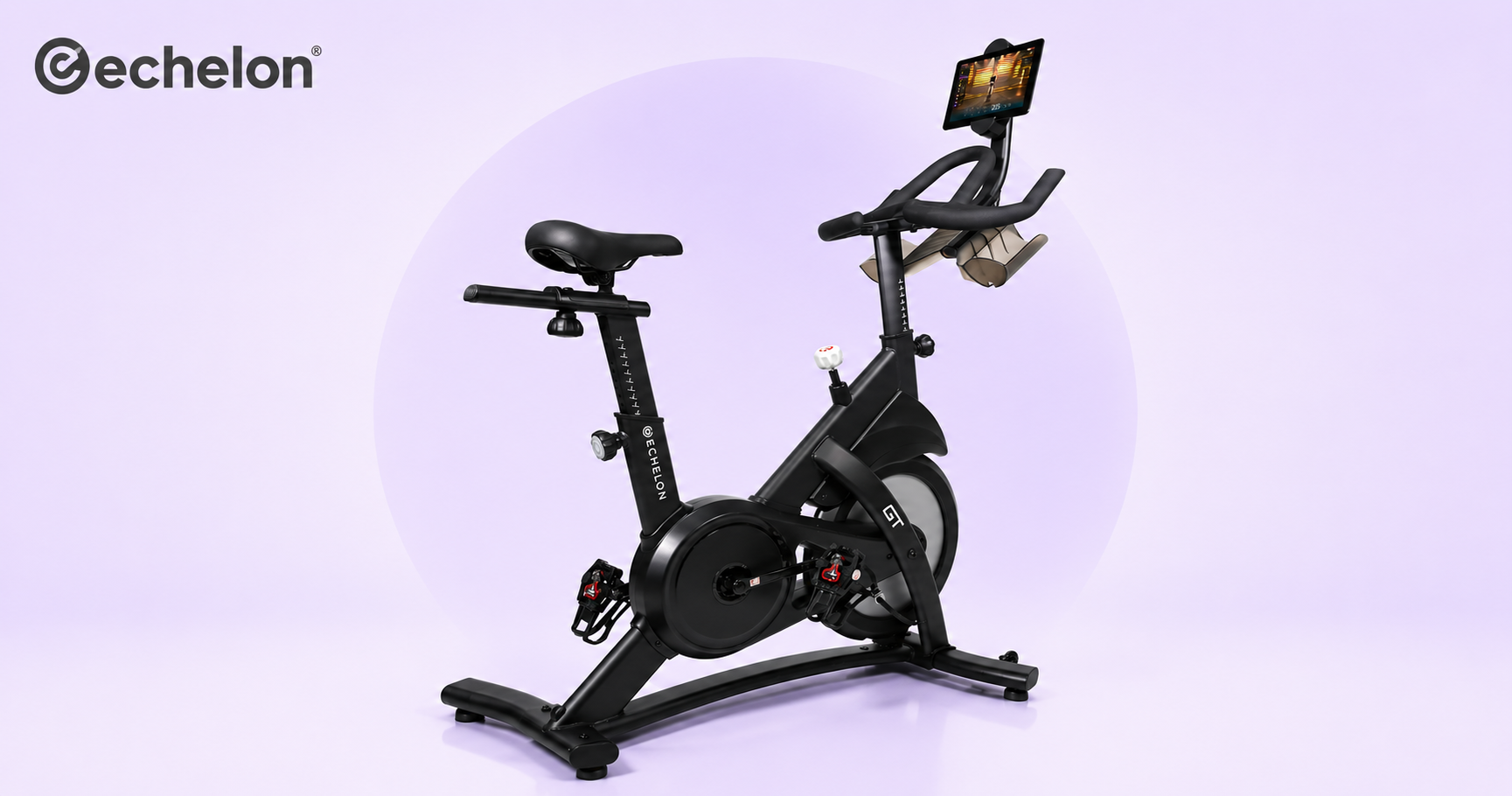
Echelon GT Smart Connect indoor cycle

Echelon · Indoor Cycle Review

Echelon GT Review 2026

The Echelon GT sits a rung above the entry EX-30, and the upgrades are the kind you feel: SPD-compatible pedals, mains power and a slip-resistant multi-grip bar. You still bring your own screen, but it is a more complete bike for not much more money.

Echelon GT Smart Connect indoor cycle

Echelon GT

Entry connected indoor cycle

4.1/5
FitRank
Very good
Performance4.0
Build4.1
Value4.2
Features4.1
£499
Check price at Echelon

Price and any code applied at checkout via Sweatband

The verdict

Like the EX-30, the GT runs a 7kg flywheel and 32 magnetic levels, so the ride character is familiar: smooth, quiet and well suited to following classes. The differences are practical ones. The SPD-compatible pedals let you clip in with cycling shoes for a more efficient, secure pedal stroke, and the multi-grip handlebar gives you more hand positions for longer rides. An arm mount holds your tablet at a good viewing angle for the Echelon Fit app.

It is mains powered rather than battery, a small but welcome step up, and the usual Echelon connectivity is all present, with Bluetooth syncing to Strava, Apple Health and Fitbit. The 7kg flywheel is still the limiting factor: this is a bike for class-led and steady riding rather than heavy standing climbs, and if that is what you want, the heavier EX-5 is the better buy. As a no-screen entry bike with grown-up pedals, though, the GT makes a lot of sense.

Strengths

  • SPD-compatible pedals as standard
  • Mains powered
  • Multi-grip bar and tablet arm mount
  • Syncs with Strava, Apple Health and Fitbit
  • Strong 4.8-star owner rating

Watch-outs

  • Same light 7kg flywheel as the EX-30
  • No built-in screen
  • Best experience needs the membership
  • Pricier than the heavily discounted EX-30

Ride feel and real-world experience

The GT shares the EX-30’s 7kg flywheel, so the ride character is much the same: smooth, quiet and easy-spinning, well suited to following classes and steady cardio rather than heavy standing work. Where it pulls ahead is the contact points. The SPD-compatible pedals let you clip in with cycling shoes for a more efficient, secure stroke, and the slip-resistant multi-grip handlebar gives you more hand positions for longer rides, which makes a real difference once a session stretches past half an hour.

The magnetic resistance is quiet and adjusts through 32 levels on the knob, and the GT runs off the mains rather than batteries, so there is nothing to replace. The padded, fully adjustable seat will still feel firm at first, as competition-style saddles do, but the wide adjustment range means most riders can find a comfortable fit. You mount your own tablet on the arm mount, which holds it at a sensible viewing angle for the app.

Assembly, size and setup

Like the rest of the range, the GT goes together in around an hour with the tools provided, and the steps will feel familiar to anyone who has built a spin bike: stabilisers, pedals, seat, bars and the tablet arm mount. At 39kg it is still light enough for one person to handle, and the front transport wheels make it easy to move once built.

Living with it: noise, footprint and storage

The GT is as quiet and as easy to place as the EX-30, with the same near-silent magnetic resistance and a similar compact footprint. At 39kg it stays manageable for one person, and the transport wheels mean you can move it aside when it is not in use. Running off the mains, there are no batteries to keep topped up, so once it is set up there is very little to think about beyond the occasional wipe-down and a check that the pedals and bolts stay snug.

The Echelon app and subscription

As a Smart Connect bike the GT is built around the Echelon Fit app, with live and on-demand classes, scenic rides and a leaderboard, and a 45-day free trial of Premier Membership in the box. The classes need the ongoing membership and an internet connection to work, but the bike itself still functions as a manual magnetic trainer without one, syncing to Strava, Apple Health and Fitbit so your data is never trapped.

Is the subscription worth it?

As with every Echelon, the GT only makes sense over a plain magnetic bike if you will use the classes, so the membership maths matter and the 45-day trial is the time to decide. If you take to the instructor-led sessions and the leaderboard, the monthly fee buys you a genuine reason to keep riding. If you find you prefer your own playlist and a steady effort, a subscription-free bike such as the JTX Studio Pro gives you a heavier, app-connected ride with nothing to pay each month, which is the more honest choice for self-motivated riders.

How it compares

The GT sits in the same bracket as the subscription-free JTX Studio Pro, and the two make a clean contrast: the Studio Pro is £799 with a much heavier 16kg flywheel and Zwift support but no classes, while the GT is cheaper, lighter and built around the Echelon class platform. If classes matter most, the GT; if ride feel and no monthly fee matter most, the Studio Pro. The cheaper JTX Cyclo-3M undercuts both at £299 but drops the app ecosystem entirely. Within the Echelon range, the GT is the pick over the EX-30 if you want SPD pedals and mains power. Only the EX-5 above it changes the ride in a meaningful way, by adding the heavier 13kg flywheel; the jump from the EX-30 to the GT is about the pedals and the power supply rather than how the bike feels to ride.

Who it is for

The GT suits class-led riders who want SPD pedals and mains power without paying for a built-in screen. If you want a heavier, more road-like ride, the EX-5 is worth the step up. If you would rather the screen was built in, look at the EX-5S.

Specifications

Flywheel7kg
ResistanceMagnetic, 32 levels
ScreenNone, arm mount for your device
ConnectivityBluetooth, Echelon Fit, syncs Strava, Apple Health, Fitbit
PedalsSPD compatible plus toe cages
HandlebarSlip-resistant multi-grip
Maximum user weight136kg
Machine weight39kg
PowerMains
Warranty2 years parts and labour (home use)

Warranty and after-sales

Echelon covers the GT with a 2-year parts and labour warranty, rated for home use, the same terms as the rest of the entry range. Both components and repair labour are covered for two years from purchase, which is a fair level for a bike at this price and better on labour than rivals that drop to parts-only after year one. It is sold and supported in the UK through Sweatband, so register the bike on arrival and keep your receipt.

FitRank breakdown

Performance 4.0

A 7kg flywheel and 32 levels make for a smooth, quiet, class-oriented ride, with SPD pedals adding efficiency. Lighter underfoot than the EX-5.

Build quality 4.1

Stable and mains powered, with a 136kg user limit and a 2-year warranty. A solid entry frame.

Value 4.2

Fair at £499 for SPD pedals and mains power, though the discounted EX-30 is the bigger bargain in the range.

Features 4.1

SPD pedals, a tablet arm mount and full app syncing. No built-in screen and a basic display keep it grounded.

Frequently asked questions

What is the difference between the Echelon GT and the EX-30 RCX?
The GT adds SPD-compatible pedals, mains power and a multi-grip handlebar, while sharing the same 7kg flywheel. The EX-30 is cheaper, runs on batteries and uses toe-cage pedals.
Does the Echelon GT have a screen?
No. You mount your own tablet or phone on the arm mount to run the Echelon Fit app.
How does the GT compare with the EX-5?
The GT uses a 7kg flywheel, the EX-5 a 13kg one. If you want more momentum and a more road-like feel for standing efforts, the EX-5 is the step up; the GT is lighter and class-focused.
Does it need a subscription?
It works as a manual magnetic bike and syncs to Strava, Apple Health and Fitbit without one. The classes need Echelon Premier Membership, which includes a 45-day free trial.
Can the GT be used without a subscription?
Yes, as a manual magnetic bike with Strava, Apple Health and Fitbit syncing. The Echelon classes need the membership and an internet connection.
Is the GT noisy?
No. The magnetic resistance is near silent, so it suits flats and shared spaces.
Can I clip in with the GT pedals?
Yes. The SPD-compatible pedals take cycling cleats on one side and have toe cages with straps on the other, so you can clip in with cycling shoes or simply wear trainers.
Chris Linford, fitness equipment reviewer
Chris Linford · Fitness equipment reviewer
Chris writes the home fitness reviews across our sites, including our sister site HomeTreadmill.co.uk. He compares every machine against its rivals on UK pricing and specs, and scores each one with FitRank.

We may earn a commission if you buy through links on this page, at no extra cost to you. It never affects our FitRank score. See our affiliate disclosure.
← Back to all Echelon bikes

Echelon EX-30 RCX Review 2026

Echelon · Indoor Cycle Review

Echelon EX-30 RCX Review 2026

If you want onto the Echelon platform for as little as possible, the EX-30 RCX is the one to look at, and right now it is a genuine steal: half price, then £359.20 with the code EXTRA20. It is the entry cycle, so you bring your own tablet, but the core Echelon experience is all here.

Echelon EX-30 RCX Smart Connect indoor cycle

Echelon EX-30 RCX

Entry connected indoor cycle

4.2/5
FitRank
Very good
Performance4.0
Build4.1
Value4.6
Features4.2
£449£899
Save 50% + EXTRA20 Check price at Echelon

Price and any code applied at checkout via Sweatband

The verdict

The EX-30 RCX keeps things simple and cheap. A 7kg flywheel and 32 magnetic levels give a smooth, quiet ride that suits class-led sessions, and at 38kg with a 136kg user limit it is stable enough for everyday training. You clip a tablet or phone to the holder, open the Echelon Fit app and you are away, with the bike syncing happily to Strava, Apple Health and Fitbit over Bluetooth.

What you give up at this price is weight and polish. The 7kg flywheel is on the light side, so the ride does not have the road-like momentum of the heavier EX-5, the console is a basic LCD, and it runs off AA batteries rather than the mains. None of that matters much when you are following a class on your own screen, which is how most people will use it. For the money, especially at the discounted price, it is hard to argue with.

Strengths

  • Cheapest way onto Echelon, especially with EXTRA20
  • Smooth, quiet 7kg magnetic ride
  • Syncs with Strava, Apple Health and Fitbit
  • Tablet holder and bottle holder included
  • Strong 4.8-star owner rating on Sweatband

Watch-outs

  • Light 7kg flywheel, less momentum than the EX-5
  • Basic LCD console
  • Battery powered, not mains
  • Toe-cage pedals only, no SPD
  • Best experience needs the paid membership

Ride feel and real-world experience

On the bike, the EX-30 RCX rides the way its spec sheet suggests: light, smooth and quiet. The 7kg flywheel is the lightest in the Echelon range, so it spins up easily and suits steady, class-led riding rather than heavy out-of-the-saddle efforts, where you notice the lack of momentum that the heavier 13kg bikes carry. The magnetic resistance is near silent, which is the recurring theme across the Echelon range, so it is genuinely flat-friendly and will not disturb anyone in the next room. You adjust resistance manually with the knob, and the LCD keeps you posted on speed, distance, time, calories and pulse.

The seat and handlebars adjust up, down and along, so most riders can dial in a comfortable position, though as with most spin bikes the firm competition-style saddle takes a few rides to get used to, and many owners add a gel cover or wear padded shorts. Because there is no built-in screen, you mount your own tablet, which keeps the bike light at 38kg and easy to wheel out of the way on its front transport wheels.

Assembly, size and setup

Assembly is straightforward and will feel familiar if you have built a spin bike before. You fit the stabilisers, pedals, seat, handlebars and the holders, with the tools supplied in the box, and most people are riding within an hour. At 38kg it is one of the lighter bikes in the range, so a single person can manage the build and reposition it afterwards. The footprint is compact at roughly 120 by 63cm, and the front transport wheels make it easy to tuck away between sessions.

Living with it: noise, footprint and storage

Living with the EX-30 RCX is easy. It is one of the quietest and most compact bikes here, with a footprint of around 120 by 63cm, so it slots into a spare corner or a bedroom without dominating the room. At 38kg it is light enough to wheel away on its front transport wheels between sessions, which makes it a sensible choice for a flat or a shared space where the bike cannot live out permanently. The only ongoing upkeep is the odd set of AA batteries for the console and the usual wipe-down after a sweaty ride.

The Echelon app and subscription

The EX-30 RCX is a Smart Connect bike, so the draw is the Echelon Fit app: live and on-demand classes, scenic rides and a leaderboard, with a 45-day free trial of Echelon Premier Membership included. After that the membership renews monthly, and it is worth being clear-eyed that the smart side of any Echelon needs both the subscription and an internet connection to shine. Without the membership you can still ride the bike manually and sync your sessions to Strava, Apple Health and Fitbit over Bluetooth, but you lose the classes, which are the main reason to choose an Echelon in the first place.

Is the subscription worth it?

Whether the membership is worth it is the real question with any Echelon, and on the cheapest bike it cuts both ways. The classes are the whole point of buying an EX-30 rather than a plain magnetic bike, so if you will actually use them, the membership earns its keep. If you suspect you will drift towards riding on your own, be honest with yourself first, because a subscription-free bike like the JTX Cyclo-3M does the manual-riding job for less up front and nothing per month. Use the 45-day trial to work out which kind of rider you are before the first payment lands.

How it compares

At this price the obvious cross-shop is our top budget pick, the JTX Cyclo-3M at £299. The Cyclo-3M is cheaper and similarly light, but it has no class platform of its own, so the EX-30 RCX earns its premium if you specifically want instructor-led classes. Step up to the subscription-free JTX Studio Pro at £799 and you get a much heavier 16kg flywheel and Zwift support with no monthly fee, which is the better buy if you would rather own your ride outright than rent the classes. Against Peloton, the EX-30 undercuts it heavily, since Peloton starts far higher and locks you into its own membership.

Who it is for

Buy the EX-30 RCX if you want the Echelon classes on a budget and already own a tablet to run them. It is the natural starting point, and the current discount makes it the best-value bike in the range. If you want a heavier, more road-like ride, step up to the EX-5. If you would rather the screen was built in, look at the EX-5S.

Specifications

Flywheel7kg
ResistanceMagnetic, 32 levels
ConsoleLCD: speed, distance, time, calories, pulse
ScreenNone, bring your own tablet
ConnectivityBluetooth, Echelon Fit, syncs Strava, Apple Health, Fitbit
PedalsToe cage
Maximum user weight136kg
Machine weight38kg
FootprintAbout 120 x 63cm
PowerAA batteries
Warranty2 years parts and labour (home use)

Warranty and after-sales

Echelon covers the EX-30 RCX with a 2-year parts and labour warranty, rated for home use. In practice that means both the components and the cost of any repair work are covered for two years from purchase, which is a reasonable level of cover for a budget connected bike and, on labour in particular, more generous than some rivals that only cover labour for the first year. It is sold in the UK through Sweatband, so warranty and support run through Echelon and the retailer. Register the bike when it arrives and keep your proof of purchase in case you ever need a repair.

FitRank breakdown

Performance 4.0

A 7kg flywheel and 32 magnetic levels handle class-led riding and steady cardio well. Smooth and quiet, though lighter underfoot than the heavier bikes in the range.

Build quality 4.1

Solid and stable for an entry cycle, with a 136kg user limit and a 2-year warranty. The lighter, battery-powered build is what keeps the price down.

Value 4.6

The standout. Half price, then £359.20 with EXTRA20, for a fully connected Echelon bike is exceptional value and the main reason to buy it.

Features 4.2

App connectivity, third-party syncing and the class library are all here. It loses ground only on the basic LCD and the lack of a built-in screen or SPD pedals.

Frequently asked questions

Does the Echelon EX-30 RCX have a screen?
No. It has a basic LCD for your stats, and you mount your own tablet or phone to run the Echelon Fit app and its classes.
How much is the EX-30 RCX with the EXTRA20 code?
It drops to £359.20, which is half price and then a further 20% off with the code EXTRA20. Sale prices change, so check the current offer before buying.
Is the flywheel heavy enough?
At 7kg it is the lightest in the range, which suits class-led and steady riding. If you want the momentum for hard standing climbs and sprints, the 13kg EX-5 is the better choice.
How long does assembly take?
About an hour with the supplied tools, and one person can manage it. The bike weighs 38kg and moves on front transport wheels.
Does it need a subscription?
Not to function. You can ride it as a manual magnetic bike and sync to Strava, Apple Health or Fitbit. The classes need Echelon Premier Membership, which comes with a 45-day free trial.
Can I use the EX-30 RCX without the internet?
The manual resistance works offline, and you can track rides through Strava, Apple Health or Fitbit. The Echelon classes themselves need an internet connection.
What is the footprint of the EX-30 RCX?
Roughly 120cm long by 63cm wide, which is compact for an indoor cycle, and the front transport wheels make it easy to move.
Chris Linford, fitness equipment reviewer
Chris Linford · Fitness equipment reviewer
Chris writes the home fitness reviews across our sites, including our sister site HomeTreadmill.co.uk. He compares every machine against its rivals on UK pricing and specs, and scores each one with FitRank.

We may earn a commission if you buy through links on this page, at no extra cost to you. It never affects our FitRank score. See our affiliate disclosure.
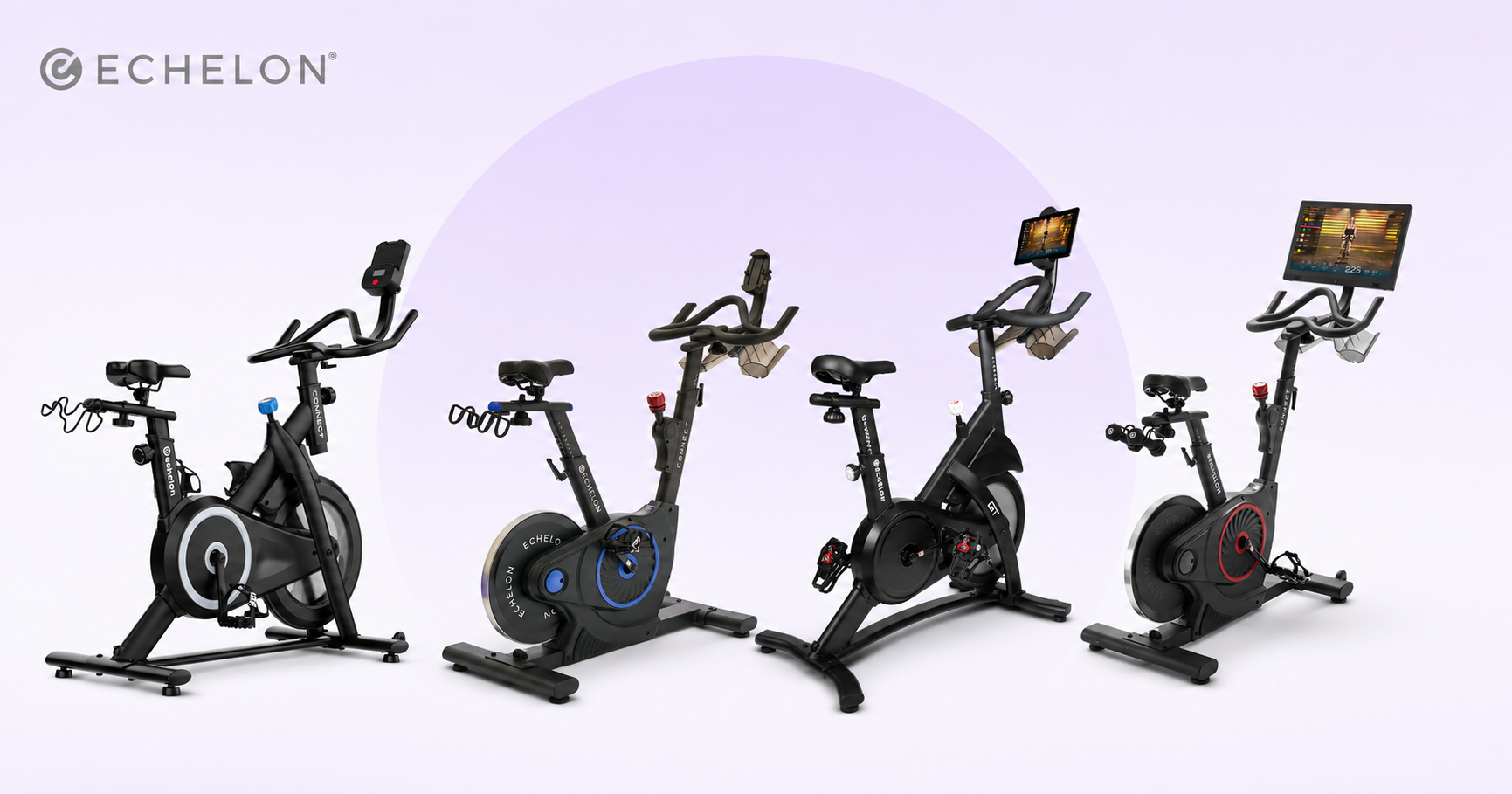
← Back to all Echelon bikes

Echelon Exercise Bikes: The Full Range Compared

The Echelon exercise bike range compared: EX-30 RCX, GT, EX-5, EX-5S, EX7s and EX-Pro

Brand Hub

Echelon Exercise Bikes: The Full Range Compared

Echelon is the main subscription-based rival to Peloton in the UK, and its indoor bikes run from a £359 entry cycle to a £2,999 commercial flagship with a 24-inch touchscreen. Here is the full Echelon bike range, scored with FitRank and grouped by whether you bring your own screen or the bike has one built in.

Echelon is one of the biggest names in connected indoor cycling. Every bike pairs manual magnetic resistance with the Echelon Fit app, which streams live and on-demand classes led by instructors, and each one ships with a 45-day free trial of Echelon Premier Membership. The range splits into two clear camps. On the more affordable bikes you bring your own screen, clipping a tablet or phone to a holder to run the app. On the premium bikes a large HD touchscreen is built in, so everything happens on the bike itself. In the UK the range sells through Sweatband, and every model carries a 2-year warranty.

All six bikes share the same core: 32 levels of magnetic resistance, Bluetooth, and syncing with Strava, Apple Health and Fitbit through the Echelon Fit app. What changes as you move up the range is the flywheel weight, the screen, the frame and the warranty class. We have scored each one with FitRank and grouped them below.

Bring your own screen

You mount a tablet or phone to run the Echelon Fit app. The cheaper, more flexible way onto the platform.

Echelon EX-30 RCX Smart Connect indoor cycle
Budget pick

Echelon EX-30 RCX

FitRank 4.2£449£89950% off + EXTRA20

Echelon’s entry cycle and, right now, its biggest bargain: half price, then £359.20 with code EXTRA20. A 7kg flywheel and 32 magnetic levels, you supply the tablet. The cheapest way onto the Echelon platform.

Echelon GT Smart Connect indoor cycle
Entry

Echelon GT

FitRank 4.1£499

A step up from the EX-30 with the same 7kg flywheel and 32 levels, plus SPD-compatible pedals and a slip-resistant multi-grip bar. You supply the screen via the arm mount.

Echelon EX-5 Smart Connect indoor cycle
Best ride, no screen

Echelon EX-5

FitRank 4.3£799£999Save 20%

The pick if you want a proper ride without paying for a built-in screen. A heavier 13kg flywheel, SPD pedals and a competition-style seat, with your own tablet running the classes.

Built-in HD touchscreen

A large rotating screen is part of the bike, so the classes, metrics and off-bike workouts all run on board.

Echelon EX-5S Smart Connect indoor cycle
Best touchscreen value

Echelon EX-5S

FitRank 4.5£1,099£1,349Save 19%

The value sweet spot of the touchscreen range. A 22-inch rotating HD screen and a 13kg flywheel for around £1,099, most of the EX7s experience for several hundred pounds less.

Echelon EX7s Smart Connect indoor cycle
Premium

Echelon EX7s

FitRank 4.4£1,999

A premium connected bike with a 22-inch rotating HD touchscreen, quiet belt drive and a heavy-duty frame rated for light-commercial use. Built for immersion.

Echelon EX-Pro Commercial connected indoor cycle
Commercial flagship

Echelon EX-Pro

FitRank 4.5£2,999

The commercial flagship: a 24-inch HD touchscreen that flips 180 degrees, fast-reacting EMS indexing resistance, aero bars and a 159kg user limit. Studio-grade, priced to match.

Echelon exercise bikes compared

ModelFlywheelScreenPedalsMax userPriceFitRank
EX-30 RCX7kgNone (bring your own)Toe cage136kg£449 (£359.20 with EXTRA20)4.2
GT7kgNone (bring your own)SPD + toe cage136kg£4994.1
EX-513kgNone (bring your own)SPD + toe cage136kg£7994.3
EX-5S13kg22″ rotating HDSPD + cage136kg£1,0994.5
EX7sMagnetic, belt drive22″ rotating HDSPD + cage136kg£1,9994.4
EX-ProEMS indexing, belt drive24″ rotating HDSPD + cage159kg£2,9994.5

All six share 32 levels of magnetic resistance, Bluetooth, a 2-year warranty and the Echelon Fit app, which syncs with Strava, Apple Health and Fitbit. The EX7s and EX-Pro are rated for commercial use.

The Echelon subscription, explained

Echelon’s bikes are built around Echelon Premier Membership, the paid subscription that unlocks the live and on-demand classes, the leaderboard and the scenic rides through the Echelon Fit app. Every bike includes a 45-day free trial, after which the membership renews monthly unless you cancel. Echelon updates its pricing from time to time, so check the current monthly cost on Echelon’s site before you commit, because over a few years the membership can add up to more than the bike itself.

The important thing to know is that an Echelon bike is not bricked without a subscription. You can still ride it as a manual magnetic bike, adjust the 32 resistance levels yourself, and track your sessions through Strava, Apple Health or Fitbit. What you lose without the membership is the classes, which are the main reason to buy an Echelon in the first place. So when you are weighing an Echelon against a subscription-free bike like a JTX, you are really deciding whether the instructor-led classes are worth the ongoing fee to you.

Echelon discount codes and sales

Echelon and Sweatband run frequent promotions, and there are usually real savings to be had rather than paying full RRP. At the time of writing the EX-30 RCX is half price and drops to £359.20 with the code EXTRA20, the EX-5 has 20% off, and the EX-5S has 19% off. Codes and sale prices change, and the best Echelon deals in the UK tend to appear through Sweatband, so it is worth checking the current offer before buying. We flag the live discount on each bike in the cards above.

What about the EX3, Connect Sport and older Echelon bikes?

If you have been researching Echelon for a while you will have seen the EX3, the Connect Sport and the Sport Smart Connect bikes. These are earlier or differently badged models, and they are not part of the current UK line-up at Sweatband. If you read an Echelon EX3 review and liked the look of it, the closest current equivalents are the entry-level EX-30 RCX and the GT, both of which use the same bring-your-own-screen approach and a 7kg flywheel. Step up to the EX-5 or EX-5S and you get the heavier 13kg flywheel and, on the EX-5S, a built-in touchscreen.

How to choose an Echelon bike

Built-in screen, or bring your own?

This is the first decision, and it is mostly about money. The EX-30 RCX, GT and EX-5 have no screen, so you mount a tablet or phone and run the Echelon Fit app from that. It keeps the price down and many people already own a suitable tablet. The EX-5S, EX7s and EX-Pro have a large rotating HD touchscreen built in, which is more immersive and lets you flip the screen for off-bike classes like strength and yoga, but you pay several hundred pounds more for the convenience.

How heavy a flywheel?

The 7kg flywheel on the EX-30 RCX and GT is fine for class-led riding and steady cardio. If you want a weightier, more road-like feel, particularly for standing climbs and sprints, the 13kg flywheel on the EX-5 and EX-5S is the one to look for. The commercial EX7s and EX-Pro use heavier-duty magnetic systems again, with the EX-Pro’s fast-reacting indexing resistance aimed at studio-style class changes.

Which one for the money?

If you just want onto the platform as cheaply as possible, the discounted EX-30 RCX is unbeatable value right now. For the best ride without a screen, the EX-5. For the best all-in-one, the EX-5S is the value pick of the touchscreen bikes, with the EX7s and EX-Pro reserved for those who want a premium or light-commercial machine.

Is Echelon a good brand?

Echelon is one of the established names in connected fitness, and several of its bikes carry strong 4.8-star ratings on Sweatband. The appeal is a large class library, open syncing with Strava, Apple Health and Fitbit, and a hardware range that, unlike some rivals, lets you start cheaply by bringing your own screen. The catch is the same as with any subscription platform: the best of the experience sits behind the membership, so the ongoing cost matters as much as the up-front price. If you will use the classes, Echelon is a strong buy. If you only want a manual magnetic bike, you can spend less elsewhere.

Echelon versus Peloton

Echelon and Peloton are the two big subscription class platforms, and the comparison usually comes down to cost and flexibility. Echelon’s hardware is generally cheaper, its membership typically undercuts Peloton’s, and its bring-your-own-screen bikes let you start for a few hundred pounds rather than four figures. It also plays more openly with third-party apps such as Strava and Apple Health. Peloton’s counter is a slicker, more polished all-in-one ecosystem and a larger, more famous class community. For value and flexibility, Echelon makes the stronger case; for the most seamless out-of-the-box experience, Peloton still leads.

Echelon beyond exercise bikes

Echelon is not only a bike brand. It also makes rowing machines and the Stride line of treadmills, all running through the same Echelon Fit app and membership. If you are building a connected home gym around the platform, it is worth looking at the range as a whole. For treadmills specifically, our sister site HomeTreadmill.co.uk covers the category in depth.

Frequently asked questions

Do Echelon bikes need a subscription?
Not to function. You can ride any Echelon bike as a manual magnetic bike and track sessions through Strava, Apple Health or Fitbit. The Echelon Premier Membership unlocks the live and on-demand classes, which are the main draw, and every bike includes a 45-day free trial before it renews monthly.
Which Echelon bike is the best value?
Right now the EX-30 RCX is the cheapest way onto the platform at £359.20 with code EXTRA20. If you want a built-in touchscreen, the EX-5S is the value pick, offering a 22-inch rotating screen and 13kg flywheel for well under the price of the EX7s.
What is the difference between the EX-5 and the EX-5S?
Both share the same 13kg flywheel and ride quality. The EX-5 has no screen, so you bring your own tablet, while the EX-5S adds a 22-inch rotating HD touchscreen built into the bike. The EX-5S costs more but is fully self-contained.
Do all Echelon bikes have a screen?
No. The EX-30 RCX, GT and EX-5 have no built-in screen, so you mount your own device. The EX-5S, EX7s and EX-Pro have large rotating HD touchscreens built in.
Is there an Echelon discount code?
At the moment the EX-30 RCX drops to £359.20 with the code EXTRA20, and the EX-5 and EX-5S have money off. Echelon and Sweatband run regular promotions, so it is worth checking the current sale before you buy.
Can I use an Echelon bike with Zwift or Peloton?
Echelon bikes are built around the Echelon Fit app and sync with Strava, Apple Health and Fitbit. They are not designed to run the Peloton or Zwift apps natively, so if those platforms are essential, check compatibility before buying.
What warranty do Echelon bikes come with?
All six carry a 2-year parts and labour warranty. The EX7s and EX-Pro are built to a commercial standard, with the EX-Pro rated for unlimited commercial use.

For exercise bikes beyond Echelon, see our main best exercise bikes guide, and read how we score every product on the FitRank page.

Chris Linford, fitness equipment reviewer
Chris Linford · Fitness equipment reviewer
Chris writes the home fitness reviews across our sites, including our sister site HomeTreadmill.co.uk. He compares every machine against its rivals on UK pricing and specs, and scores each one with FitRank.

← All exercise bikes