
JTX · Air Bike Review
JTX Ignite AirX Rider Review 2026
The Ignite AirX Rider is JTX’s erg-style air bike, and it is built for people who quietly enjoy the hurt of interval training. A freewheel, dynamic air resistance and a properly serious performance console, all for £799. If you want an air bike that rewards effort the way a good rower does, this is the one to look at.
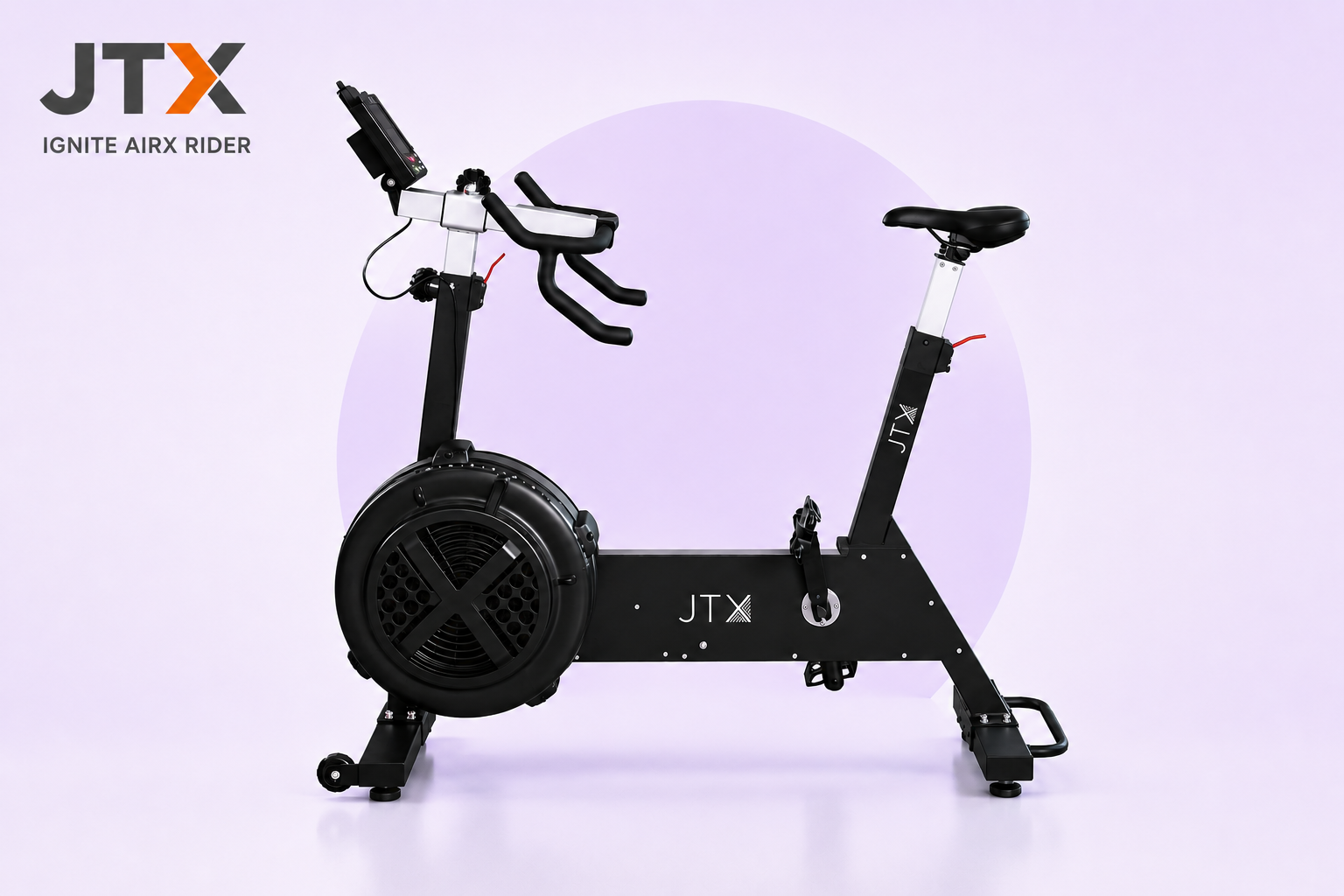
JTX Ignite AirX Rider
Commercial-grade erg-style air bike
Price and discount applied at checkout on jtxfitness.com
The verdict
Air bikes come in two flavours: the full-body fan bike with moving arms, and the seated erg-style rider built for the legs and lungs. The AirX Rider is firmly the second kind. Thanks to the freewheel and dynamic air resistance, it pushes back exactly as hard as you do, scaling from gentle zone-two spinning to eyeballs-out sprint intervals without a resistance dial anywhere in sight. The 160kg user limit and commercial-grade build mean it shrugs off the repeated hammering that interval work dishes out.
What lifts it above a bog-standard air bike is the console. On top of the usual numbers it gives you drag factor, pace, watts, interval and split data, and it stores your history, which is performance-rower territory and exactly what structured training lives on. It talks to Zwift, too. For a £799 home machine pointed at HYROX-style and race prep, that is a strong hand.
Strengths
- Freewheel and dynamic air resistance that scales infinitely with effort
- Performance console with drag factor, pace, splits and history
- Commercial-grade build, 160kg maximum user weight
- Connects to Zwift, interchangeable universal seat
- Self-powered, no mains needed
Watch-outs
- Moderate fan noise, as with any air bike
- SPD pedals suit cycling shoes more than trainers
- Seated rider format, not a full-body fan bike with arms
- 2-year home warranty, shorter than the Studio Pro’s 3
Ride feel and real-world experience
The Ignite AirX Rider rides like the race-focused tool it is. Air resistance has a character all of its own: there is no knob to set, because the faster and harder you pedal, the more the fan pushes back, so the bike scales seamlessly from a gentle warm-up to an all-out sprint and never runs out of resistance. The seated, erg-style position keeps the focus on your legs and lungs rather than the full-body push-pull of a fan bike, and the freewheel lets you coast, which matters for interval work where you back off between efforts.
Air bikes are inherently louder than magnetic spin bikes, since the fan moves a lot of air, so the AirX Rider carries a moderate noise rating: noticeable but not unreasonable for a home, and far from the loudest air bike out there. The commercial-grade build and 160kg user limit mean it stays planted through hard efforts, and the standout is the performance console, which reports drag factor, pace, watts, splits and stored history, the kind of data structured and race training actually uses. It connects to Zwift, and the interchangeable seat lets you fit a saddle you prefer.
Assembly, size and setup
The AirX Rider comes with the tools needed and goes together in around an hour. At 43kg it is lighter than the spin bikes but still easier to position with two people, partly because of its size: it is a tall, long machine at 144 by 62 by 150cm, so measure your space, including headroom, before it arrives. It is self-powered, so there is no need to place it near a socket, and transport wheels help you move it once built.
Living with it: noise, footprint and storage
The things to plan for are noise and space. As an air bike the AirX Rider is louder than a magnetic spin bike, so it is less suited to a flat with thin walls or late-night use next to a sleeping household, though it is far from the noisiest air bike around. It is a large machine that wants a proper footprint, and being self-powered it can go anywhere there is room rather than near a plug. Upkeep is minimal, with no resistance pads to wear, just the occasional wipe-down.
Apps and connectivity
The AirX Rider connects to Zwift over Bluetooth, which is unusual and welcome on an air bike, letting you ride virtual routes and structured sessions on your own screen. As with the rest of the JTX range there is no compulsory subscription. Its own performance console is the real draw, though, with rower-grade data including drag factor, pace, splits and workout history, plus Polar H10 chest-strap heart-rate support, so structured training works fully on the bike alone.
Running costs: the no-subscription advantage
As with the rest of the JTX range, the AirX Rider carries no compulsory subscription, which matters more than it sounds. Its performance console is fully featured out of the box, so the drag factor, pace, splits and history that structured training relies on cost you nothing on an ongoing basis. If you want virtual riding you can add Zwift on your own terms, but plenty of air-bike training, intervals, calorie sprints and conditioning work, needs no app at all. Set against a subscription bike, where the monthly fee continues for as long as you own it, the AirX Rider is a pay-once machine.
How it compares
As an air bike the AirX Rider competes less with Echelon’s spin bikes and more with dedicated fan and erg bikes like the Assault AirBike, the Schwinn AD7 and the Rogue Echo. Where most of those are full-body fan bikes with moving arms, the AirX Rider is a seated erg-style rider, closer in spirit to a leg-and-lung erg machine, and its performance console matches or beats theirs for data. Within the JTX range, if you want the full-body push-pull instead, the Mission Air is the fan bike to choose, and if you would rather a quiet magnetic spin bike for class-style riding, the Studio Pro is the better fit.
Who it is for
This is the bike for interval and race training, anyone doing HYROX, CrossFit-style conditioning or structured cycling who wants honest, effort-scaled resistance and the data to train by. If you would rather have a full-body air bike that works your arms as well as your legs, look at the JTX Mission Air instead. For a broader look at where air bikes sit against spin bikes, the JTX exercise bikes hub lays out the whole range.
Specifications
| Bike type | Erg-style air bike, freewheel |
|---|---|
| Resistance | Air, dynamic (10 levels of damper) |
| Maximum user weight | 160kg |
| Console | Distance, time, RPM, pace, calories, watts, heart rate, drag factor, interval and split data, workout history |
| Connectivity | Wireless, Zwift |
| Heart rate | Polar H10 chest strap |
| Power supply | Batteries (self-powered) |
| Pedals | SPD |
| Seat | Interchangeable universal seat, vertical and horizontal adjustment |
| Assembled size (l x w x h) | 144 x 62 x 150 cm |
| Machine weight | 43kg |
| Warranty | 2-year in-home repair, 10-year frame, 1-year commercial |
| Usage class | Commercial |
Warranty and after-sales
The AirX Rider carries a two-year in-home repair warranty covering parts and labour, a 10-year guarantee on the frame, and a one-year commercial warranty, with cover registered automatically at purchase and a 28-day no-quibble returns policy. As with all JTX kit, in-home repair means an engineer comes to you rather than you returning the bike. Two years of parts-and-labour cover plus a decade on the frame is a strong package for an air bike, and matches or beats what most dedicated air-bike brands offer.
FitRank breakdown
Performance 4.7
Freewheel air resistance that scales with effort makes this genuinely excellent for intervals and endurance alike. The harder you ride, the more it gives back, with no ceiling to hit.
Build quality 4.7
Commercial-grade construction and a 160kg user limit, sharing the build and warranty of JTX’s well-rated rower. Comfortably rated for repeated high-intensity sessions.
Value 4.4
A performance air bike with rower-grade data for £799 is competitive, though air bikes are a more niche buy than spin bikes, which tempers the score slightly.
Features 4.5
The standout is the console: drag factor, splits, history and Zwift support put it ahead of most home air bikes, which often ship with only a basic metrics screen.
Frequently asked questions
What is the difference between this and the JTX Mission Air?
Is it noisy?
Does it need mains power?
Can I use it with Zwift?
Is the AirX Rider a full-body workout?
Who is the AirX Rider best for?

Chris writes the home fitness reviews across our sites, including our sister site HomeTreadmill.co.uk. He compares every machine against its rivals on UK pricing and specs, and scores each one with FitRank.
We may earn a commission if you buy through links on this page, at no extra cost to you. It never affects our FitRank score. See our affiliate disclosure.